

Ne manquez aucune mise à jour!

Sur le terrain
Explorez notre travail avec des partenaires, à l'échelle mondiale, pour lutter contre l'injustice sociale et économique sous l’angle des droits de l'Homme.
174 organisations de la société civile appellent à cesser le soutien à BIA
174 organisations de la société civile appellent à cesser le soutien à Bridge International Academies
POUR DIFFUSION IMMÉDIATE
174 organisations de la société civile à travers le monde appellent les investisseurs de la chaine d’école américaine Bridge International Academies à cesser leur soutien
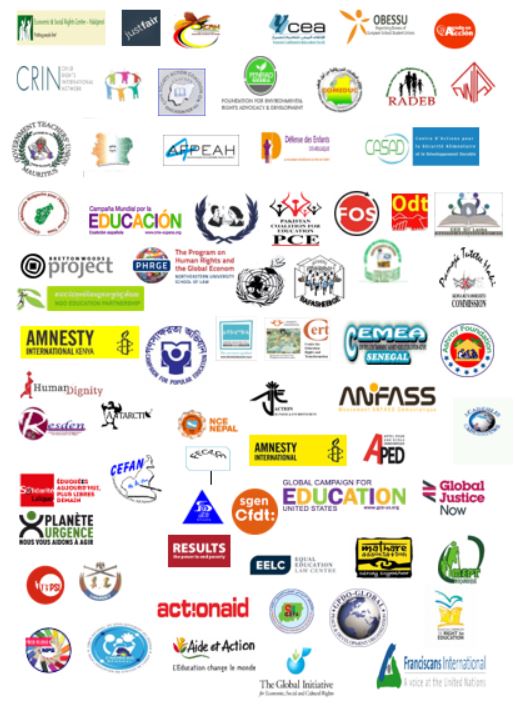
(Nairobi, Kampala, Monrovia, Johannesburg, 1er Août 2017) 174 organisations de la société civile du monde entier publient aujourd’hui une déclaration appelant les investisseurs de Bridge International Academies à cesser leur soutien à la plus grande entreprise d’écoles privées à dimension commerciale opérant dans les pays en voie de développement et soutenue par des donateurs et investisseurs internationaux.
Cette déclaration, publiée deux ans après un précédent appel similaire, a été signée par une large diversité d’organisations présentes dans 50 pays, incluant des ONG de défense des droits de l’homme, des organisations de développement, des organisations communautaires, des organisations confessionnelles, et des syndicats, démontrant l’échelle des inquiétudes sur Bridge.
La déclaration, qui recense des éléments de preuves variés et des recherches publiées au cours des deux dernières années, soulève de sérieuses préoccupations concernant la transparence de Bridge, ses relations avec les gouvernements, les conditions de travail de son personnel pédagogique et la question de la violation des normes éducatives. Elle met en évidence les cas de l'Ouganda et du Kenya où Bridge a exploité illégalement des écoles et n'a pas respecté les normes nationales d'éducation. Dans les deux pays, les autorités ont ordonné Bridge de fermer leurs écoles.
« La qualité des écoles Bridge n'a jamais été évaluée de manière indépendante. Dans tous les cas, tout gain allégué concernant les résultats d'apprentissage ne pourrait jamais justifier les pratiques choquantes qui sont rapportées dans cette déclaration. Comment justifier, par exemple, l'emploi d'enseignants non diplômés et non enregistrés, sachant qu’ils perçoivent des salaires proches du seuil de pauvreté pour plus de 60 heures de travail par semaine ? » questionneLinda Oduo-Noah du Centre de l'Afrique de l'Est pour les droits de l'homme au Kenya.
La déclaration souligne que Bridge n’est pas parvenu à atteindre les plus défavorisés, qu’ils prétendent pourtant viser, en raison des coûts de scolarité élevés qui impactent négativement les familles qui envoient leurs enfants dans ces écoles. Une étude a révélé que 69 à 83 % des parents avaient du mal à payer le loyer, à se procurer de la nourriture ou à accéder à des soins de santé à cause des frais de scolarité de Bridge.
« Au lieu des 6 US dollars par mois targué par la société, les frais totaux sont plus proches de 20 US dollars par mois. Non seulement ces coûts sont prohibitifs pour une grande partie de la population des pays dans lesquels Bridge opère, mais leurs frais annoncés sont trompeurs », souligne Salima Namusobya de l’Initiative for Social and Economic Right en Ouganda.
Le document souligne également la résistance de Bridge à tout examen public et ses tentatives pour limiter la transparence, s'appuyant sur une lettre récente du Comité du développement international du Parlement britannique au secrétaire d'État qui soulevait aussi cette question.
« Nous avons vu comment, au Liberia, Bridge, qui a un accord de partenariat public-privé avec l'État, a opéré dans le plus grand secret, contestant les règles de passation des marchés publics. Cela confirme la tendance pour d'autres pays, dans lesquels Bridge a été impliqué dans l'arrestation d’un chercheur indépendant, la réduction au silence des syndicats, la résistance à l'évaluation et plus encore. Il s'agit d'une société d'éducation mondiale enveloppée dans le secret et la dissimulation et c’est extrêmement inquiétant », s’alarme Anderson Miamen de la Coalition du Libéria pour la transparence et la responsabilisation dans l'éducation.
Les organisations signataires de la déclaration appellent donc les investisseurs et les donateurs à s'acquitter pleinement de leurs obligations de diligence et à cesser leur soutien à Bridge. Par ailleurs, les organisations énoncent un certain nombre de recommandations en respect des lois et normes nationales, de la transparence mais aussi de la responsabilisation, du traitement de la société civile et de la redirection des fonds vers des programmes favorisant l'équité dans le domaine de l'éducation.
« Il est important de reconnaître que la plupart des investisseurs cherchent vraiment à faire une différence dans la vie des enfants vivant dans la pauvreté. Nous partageons ces préoccupations et reconnaissons la nécessité d'améliorer considérablement l'éducation. Cependant, il existe maintenant des preuves significatives que l'investissement dans Bridge n'est pas un moyen efficace d'améliorer l'accès, l'équité et la qualité dans le domaine de l'éducation, ce qui devrait être l'objectif d'une initiative éducative visant les plus défavorisés. Nous serions heureux d'avoir l'occasion d'explorer des solutions alternatives avec les donateurs et les investisseurs, afin d'identifier des moyens plus efficaces d'investir durablement dans la mise en œuvre d'une éducation de qualité pour tous les enfants vivant dans la pauvreté », conclut Chikezie Anyanwu, de la Campagne mondiale pour l’éducation.
Cette dernière déclaration fait suite à des préoccupations répétées au sujet de l'expansion rapide et non réglementée de certains prestataires privés dans le domaine de l'éducation, en particulier commerciaux, tels que Bridge. En mai 2015, 116 organisations avaient publié une déclaration soulevant des inquiétudes relatives à des faits trompeurs concernant les coûts et la qualité des écoles Bridge. Dès lors, les éléments de preuve présentés dans la déclaration et résultant de diverses sources – rapport de l'ONU, rapport parlementaire du Royaume-Uni, travaux de recherches indépendants et médias – ont confirmé ces préoccupations et sonné l'alarme en raison de l’écart entre les promesses de Bridge et la réalité de leurs pratiques.
FIN
NOTES
-
Appel de la société civile aux investisseurs de cesser leur soutien à Bridge International Academies
-
A sociedade civil apela aos investidores que suspendam o apoio às Bridge International Academies: http://bit.ly/biainvestorspt
-
Lettre du parlement britannique : http://bit.ly/2ql2pa6
-
Plus d'informations sur Bridge International Academies : http://bit.ly/2mAQS46 et http://bit.ly/commerceduc
CONTACTS
-
Sylvain Aubry (français, anglais), Global Initiative for Economic, Social and Cutural Rights:
Cette adresse e-mail est protégée contre les robots spammeurs. Vous devez activer le JavaScript pour la visualiser. / +33 7 81 70 81 96 -
Delphine Dorsi (français, anglais), Right to Education Initiative :
Cette adresse e-mail est protégée contre les robots spammeurs. Vous devez activer le JavaScript pour la visualiser. -
Salima Namusobya, Executive Director, Initiative for Economic and Social Rights (ISER), Uganda:
Cette adresse e-mail est protégée contre les robots spammeurs. Vous devez activer le JavaScript pour la visualiser. / +256 414581041 -
Anderson Miamen, National Coordinator, Coalition for Transparency and Accountability in Education (COTAE), Liberia:
Cette adresse e-mail est protégée contre les robots spammeurs. Vous devez activer le JavaScript pour la visualiser. / +231 776 391 481 -
Linda Oduor-Noah, Project Manager, East African Centre for Human Rights (EACHRights), Kenya:
Cette adresse e-mail est protégée contre les robots spammeurs. Vous devez activer le JavaScript pour la visualiser. / +254 701670090 -
Chikezie Anyanwu, Global Co-ordinator, Global Campaign for Education:
Cette adresse e-mail est protégée contre les robots spammeurs. Vous devez activer le JavaScript pour la visualiser. / +27 11 447 4111
LISTE DES SIGNATAIRES
1. Action Contre la Pauvreté (ACP), Burundi
2. Action Jeunesse et Environnement (AJE), International
3. ActionAid Brazil, Brazil
4. ActionAid International, International
5. ActionAid Liberia, Liberia
6. ActionAid Uganda, Uganda
7. Africa Network Campaign on Education For All (ANCEFA), International
8. Aide et Action, International
9. AKS, Austria
10. Amnesty International, International
11. Amnesty International Kenya, Kenya
12. Amnesty International Sénégal, Senegal
13. Antarctic, Democratic Republic of Congo
14. Appel pour une école démocratique (Aped), Belgium
15. Ashroy Foundation, Bangladesh
16. ASO EPT Niger, Niger
17. Associação Nacional de Pesquisadores em Financiamento da Educação (Fineduca), Brazil
18. Association AMONTANA, Madagascar
19. Association Camerounaise Pour la Défense des Droits de l'Homme des Libertés et du bien être (ACADEHLIB), Cameroon
20. Association d'Aide et de Protection des Personnes vulnerables, Democratic Republic of Congo
21. Association des Amis du Belvédère, Tunisia
22. Association des Personnes Handicapées Motivées de Tône (APHMOTO), Togo
23. Association femmes pour l’ egalité et la démocratie, Morocco
24. Association Française Pour un Enseignement Ambitieux et Humaniste (AFPEAH), France
25. Association graine de paix, Algeria
26. Association Initiative Urbaine, Morocco
27. Association Rechida pour l"environnementet développement, Morocco
28. Association Tunisienne des Jeunes et Développement, Tunisia
29. Ayuda en Acción, International
30. Both ENDS, International
31. Bretton Woods Project, United Kingdom
32. Cameroon Education For All Network, Cameroon
33. Campaign for Popular Education (CAMPE), Bangladesh
34. Campaña Argentina por el Derecho a la Educación (CADE), Argentina
35. Campaña Latinoamericana por el Derecho a la Educación (CLADE), International
36. Campaña Peruana por el Derecho a la Educación (CPDE), Peru
37. Campanha Brasileira pelo Direito à Educação, Brazil
38. Carrefour de la famille marocaine, Morocco
39. CEMEA Sénégal, Senegal
40. Centre d'Actions pour la Sécurité Alimentaire et le Développement Durable (CASAD-Bénin), Benin
41. Centre d'Encadrement des personnes opprimées, Democratic Republic of Congo
42. Centre for Education Rights and Transformation, South Africa
43. Centre for Equity and Quality in Universal Education, India
44. Centres d'Entrainement aux Méthodes d'Education Active (CEMEA), France
45. Centro de Cultura Luiz Freire (CCLF), Brazil
46. Centro de Defesa da Criança e do Adolescente (CEDECA/Ceará), Brazil
47. Centro de Estudos Educação e Sociedade (CEDES – Unicamp), Brazil
48. Centro de Investigación, Planeación y Evaluación (CIPE Consultores), Honduras
49. Child Rights International Network (CRIN), International
50. Civil Society Action on Education for All (CSACEFA), Nigeria
51. Civil Society and Trade Union Institutions of Liberia (CTIL),Liberia
52. Coalición Española de la Campaña Mundial por la Educación, Spain
53. Coalition des organisations en synergie pour la défense de l’éducation publique (COSYDEP), Senegal
54. Coalition des organisations mauritaniennes pour l'éducation (COMEDUC), Mauritania
55. Coalition Education, France
56. Coalition Education Pour Tous BAFASHEBIGE, Burundi
57. Coalition for Educational Developpment, Sri Lanka
58. Coalition for Transparency and Accountability in Education, Liberia
59. Coalition Nationale de l'Education Pour Tous en République Démocratique du Congo (CONEPT RDC), Democratic Republic of Congo
60. Coalition nationale de Madagascar pour l'éducation accessible et inclusive (CONAMEPT), Madagascar
61. Coalition Nationale pour l’Education Pour Tous - Burkina Faso (CN-EPT/BURKINA), Burkina Faso
62. Comité National de Développement des Réseaux pour l'Education en Afrique de l'Ouest (CNDREAO), Senegal
63. Comité Syndical Francophone de l'Education et de la Formation (CSFEF), International
64. Construisons Ensemble le Monde, Democratic Republic of Congo
65. Corner House, United Kingdom
66. Counter Balance, Belgium
67. CSC-Enseignement, Belgium
68. Défense des enfants International Belgique, International
69. DEL PEP 21, France
70. East African Centre for Human Rights (EACHRights), Kenya
71. Economic & Social Rights Centre (Hakijamii), Kenya
72. Edugestion Cameroun, Cameroon
73. Environnement et Progrès ASBL, Belgium
74. Equal Education Law Centre, South Africa
75. Fédération Camerounaise des Syndicats de l'Education (FECASE), Cameroon
76. Femmes unies pour le développement, Democratic Republic of Congo
77. Fonds voor OntwikkelingsSamenwerking (FOS), International
78. Foro Dakar Honduras, Honduras
79. Foro por el Derecho a la Educación de Chile, Chile
80. Forum for Education NGOs in Uganda (FENU), Uganda
81. Foundation For Environmental Rights,Advocacy & Development FENRAD-NIGERIA, Nigeria
82. Franciscans International, International
83. Fundación Manatí para el Fomento de Ciudadanía A.C., Mexico
84. Ghana National Education Campaign Coalition, Ghana
85. Global Campaign for Education, International
86. Global Campaign for Education - US, United States
87. Global Initiative for Economic, Social and Cultural Rights (GI-ESCR), International
88. Global Justice Now, United Kingdom
89. Global Peace and Development Organization, Liberia
90. Government Teachers' Union, île Maurice
91. Grupo de Estudio Sobre Educación en Cárceles (GESEC), Argentina
92. Grupo de Estudos e Pesquisas em Política Educacional (GREPPE), Brazil
93. Homabay county education network, Kenya
94. Homabay county paralegal, Kenya
95. Human Dignity, International
96. Idealoga, Intervención Comunitaria S.Coop.Mad, Spain
97. Incidencia Civil en Educación (ICE), Mexico
98. Initiative for Social and Economic Rights (ISER), Uganda
99. Initiative For Women Empowerement & Development(IWED), Nigeria
100. International Union of Food, Agricultural, Hotel, Restaurant, Catering, Tobacco and Allied Workers' Associations (IUF), International
101. Jeunes et Femmes pour les droits de l'homme et la paix (J.F.D.HO.P), Democratic Republic of Congo
102. Jeunesse et Emplois Verts pour une Economie Verte (ONG JEVEV), Bénin
103. Just Fair, United Kingdom
104. Kenya Human Rights Commission (KHRC), Kenya
105. Kenya National Union of Teachers (KNUT), Kenya
106. Kisora, Kenya
107. Kisumu county education network, Kenya
108. Labour,Health and Human Rights Development Centre, Nigeria
109. Les Anges Du Ciel, Democratic Republic of Congo
110. Ligue des Droits de l'Enfant, Belgium
111. Lumiere Synergie pour le Développement, Senegal
112. Mathare Association, Kenya
113. Migori county education network, Kenya
114. Mouvement Anfass Démocratique, Morocco
115. Mouvement politique des objecteurs de croissance, Belgium
116. Movimento de Educação para Todos (MEPT – Moçambique), Mozambique
118. Nadi Ghati Morcha, India
119. National Campaign for Education Nepal, Nepal
120. National Teachers Association of Liberia (NTAL), Liberia
121. Natural Resources Alliance of Kenya, Kenya
122. Nepal National Teachers Association, Nepal
123. Network for Public Education, United States
124. NGO Education Partnership, Cambodia
125. Organisation Democratique du Travail, Morocco
126. Organising Bureau of European School Student Unions (OBESSU), International
127. Oxford Human Rights Hub, United Kingdom
128. Pakistan Coalition for Education, Pakistan
129. Planète Urgence, International
130. PNG Education Advocacy Network (PEAN), Papua New Guinea
131. Prayatn Sanstha, India
132. Program on Human Rights and the Global Economy (PHRGE), United States
133. Public Services International, International
134. Red de Educación Popular Entre Mujeres de Latinoamérica y el Caribe (REPEM), Latin America and Caribbean
135. Rede Angolana da Sociedade Civil de Educação para Todos (Rede EPT-Angola), Angola
136. Rede da Campanha de Educação para Todos – Guiné-Bissau (RECEPT-GB), Guiné-Bissau
137. Rede Nacional da Campanha de Educação para Todos de São Tomé e Príncipe (RNEPT-STP),São Tomé and Príncipe
138. ReLus - Lusophone Network for the Right to Education, International
139. Rencontre pour la Paix et les Droits de l'Homme (RPDH), Republic of Congo
140. Réseau des Acteurs de Développement de l’Education au Bénin (ONG RADEB), Benin
141. Réseau des Organisations pour le Développement de l'Education au Burkina (RODEB), Burkina Faso
142. Réseau Ivoirien Pour la Promotion de l'Education Pour tous, Cote d'Ivoire
143. Réseau Marocain pour la Defense du Droit à la Santé - Droit à la vie, Morocco
144. Réseau Pour le Développement de l'Education au Niger (RESDEN), Niger
145. Réseau progrès et développement humanitaire du Niger (ONG REPRODEVH NIGER), Niger
146. RESULTS Education Fund, International
147. Right to Education Forum (India), India
148. Right to Education Forum Jharkhand, India
149. Right to Education Initiative, International
150. Shala Mitra sangh, India
151. Siaya county education network, Kenya
152. Sikshasandhan, India
153. Society for International Development (SID), International
154. Society for People's Awareness (SPAN), India
155. Solidarité Laïque, France and International
156. SOLIDARITE-UNAFETPCI (Union Nationale des Formateurs de l'Enseignement Technique et Professionnel de Côte d'Ivoire), Côte d'Ivoire
157. Star of the lake CBO, Kenya
158. StopTFF, France
159. Sudanese Coalition for Education for All, Sudan
160. Sustaining Continuity in Education Foundation, Nigeria
161. Syndicat des Enseignants Romands, Switzerland
162. Syndicat des Travailleurs des Etablissements Privés du Cameroun (SYNTESPRIC), Cameroon
163. Syndicat général de l'éducation nationale - Fédération (Sgen-CFDT), France
164. Syndicat général de l'enseignement de base (SGEB), Tunisia
165. Syndicat National Autonome de l'Enseignement Secondaire, Cameroon
166. Syndicat national de l'enseignement supérieur Fédération syndicale unitaire (SNESUP-FSU), France
167. Syndicat National des Agents de la Formation et de l'Education du Niger (SYNAFEN -NIGER), Niger
168. Syndicat National des Formateurs de l'Enseignement Technique et de la Formation Progessionnelle (SYNAFETP-CI), Côte d'Ivoire
169. The Kairos Center for Relgions, Rights and Social Justice, United States
170. Union Nationale des Normaliens/Normaliennes et Educateurs/Educatrices d'Haïti (UNNOEH), Haiti
171. UNISON, United Kingdom
172. Unnati Institute for Social and Educational Change, India
173. Yemeni Coalition for Education for All, Yemen
174. Youth Progressive Association in Taraba, Nigeria
Related Articles
SITEMAP
TAKE ACTION
NEWSLETTER
