


Accessibility Tools
Between 24 and 29 April, the First Conference on Transitioning Away from Fossil Fuels took place in Santa Marta, Colombia. The Conference, hosted by Colombia and the Netherlands, was set up in response to the lack of meaningful, implementation-oriented outcomes to give effect to the commitment of transitioning away from fossil fuels at the multilateral level. It also aimed to advance practical pathways for a just, orderly and equitable transition.
Read more here.
Throughout the Conference, we participated in debates and strategic spaces with feminists, civil society organisations, government representatives and other stakeholders, bringing a human rights and gender-just perspective to discussions on defossilisation to ensure that the transition is centred on the needs of people and planet. Our contributions highlighted the structural inequalities underpinning the climate emergency and strongly emphasised that any transition must be gender-just and care-centred.
We also joined collective civil society efforts to emphasise that any transition framework must be grounded in human rights, including the rights to participation, access to information and free, prior and informed consent. In this context, our interventions underscored the importance of ensuring the protection of environmental and land defenders and that affected communities can meaningfully engage in decision-making processes shaping the transition away from fossil fuels.
First Conference on Transitioning Away from Fossil Fuels
From 27 to 29 April, Colombia and the Netherlands hosted the two formal spaces of discussion that constituted the official Conference: the Assembly of the People and the High-Level Segment.
The Assembly of the People served as a forum to bring together feminists, social movements, groups, NGOs and other stakeholders and a space where the collective demands could be delivered into the formal process. The Assembly hosted a total of 250 participants, including 60 elected representatives from the movement-led People's Summit.
The High-Level Segment was the main space for debate among the States and deliberation. It included a series of dialogues, both in plenary and divided into working thematic sessions, around the three interconnected thematic pillars of the Conference:
The participation of civil society was limited due to the bottleneck approach established by the hosts. During the Assembly of the Peoples, each of the chapters that civil society was divided into (NGOs, Women and Diversities, Social Movements, Afrodescendants, Indigenous Peoples, Farmers and Youth) elected representatives to attend the High-Level Segment. GI-ESCR's Programme Officer on Climate and Environmental Justice, Maggie Rochi, was elected to represent the Women and Diversities chapter. Representatives from Trade Unions, Academia, the Private Sector and Parliamentarians also participated.
The formal spaces of the Conference saw substantive debates, beyond the formal outcomes that came from the process. On the question of economic dependence on fossil fuels, discussions had a significant emphasis on moving from fiscal lock-in and debt-constrained fiscal space toward higher fiscal capacity, with concrete proposals including debt-for-climate swaps, progressive tax reform and strengthened oversight of fossil assets.
On supply and demand transformation, the discussions emphasised the need for a managed phase-down of fossil fuel extraction, clear policy signals and long-term planning, and the importance of community-led approaches and participation to build legitimacy for the transition. Similarly, the focus on energy access for rural, remote and marginalised communities, and the call for community-owned distributed renewable systems, reflects a commitment to ensuring the transition reaches everyone. However, there was a notable gap in discussions: care responsibilities and their centrality to a just transition were largely absent.
At the end of the Conference, Colombia and the Netherlands published the takeaways of the Conference. This document marks an important political step; it presents the imperative of the transition away from fossil fuels and highlights the commitment of a coalition of willing states, representing approximately one-third of global GDP, to move towards a fossil-free future. While recognising the current context of geopolitical instability and market volatility, the document goes further in considering the transition to be essential, not only for climate mitigation, but also for energy security and economic resilience. By doing so, it distances itself from the limited outcomes achieved within the UNFCCC process in recent editions, creating a political pathway for accelerated climate action.
The official document highlights five key outcomes of the meeting:
Santa Marta Must Strengthen the UNFCCC, Not Become a Parallel Track
Tuvalu’s role as co-host carries strong symbolic and political weight. It also indicates that the next conference could be shaped by countries with high levels of ambition and a clear interest in translating commitments into concrete policies.
At the same time, both the second and third outcomes speak to one of the central tensions of the Santa Marta process: the relationship between this coalition of willing States and the broader multilateral system. While efforts such as Santa Marta can be powerful drivers of ambition, their impact ultimately depends on whether that ambition feeds back into more permanent frameworks or regimes. A coalition that advances bold positions outside the UNFCCC risks becoming a parallel track that empties the multilateral system rather than reinvigorates it, while not creating an effective replacement of the existing frameworks. A political convening is very different from a binding treaty, with clear legal obligations for States. For Santa Marta to fulfil its potential, the dedicated group must be a lever to push the UNFCCC and the Member States that have historically obstructed progress toward a fossil-free future. The value of a club of the willing will be to push the multilateral system to finally act.
Implementation Tools Must Reflect Rights, Care and Frontline Priorities
Regarding the three thematic workstreams, there is some concern regarding an overly economic and financial framing, risking the production of recommendations that are financially coherent but ignore the human rights implications of the transition. Their value will also depend on their design and analytical scope. Tuvalu’s role as co-host of the next conference could help ensure that they reflect the priorities of frontline communities and the Global South.
Lastly, the launch of a Science Panel for the Global Energy Transition places science at the centre of the process, helping to anchor decisions in pathways aligned with the 1.5°C goal and to address legal, financial and political barriers to transition. This is a welcome step, provided the Panel’s mandate is broad and inclusive. Science should not be reduced to technical or economic modelling; it must also include the social, gender and human rights dimensions of the transition. Otherwise, the Panel risks producing roadmaps that are technically sound but disconnected from realities on the ground. It will also be important to ensure coherence with other initiatives, such as the future Belém-Antalya Mechanism and the ILO Just Transition Gateway.
The Test Is Whether Santa Marta Can Shape Real Multilateral Action
The takeaways document also includes a Summary of discussions that reflects a meaningful step forward in building the shared understanding and political will needed to advance a just transition away from fossil fuels. Together, these discussions show that implementation depends on more than technical energy planning. It also requires fiscal capacity, public finance, participation, rights-based governance and international cooperation. Colombia and the Netherlands are expected to release a full co-host report of the Conference at London Climate Week, which will hopefully further develop the discussions that took place in Santa Marta. It will be key that these discussions find their way into formal UNFCCC processes, feeding into upcoming negotiations and contributing to the kind of ambitious, rights-based and gender-just outcomes that the climate emergency demands. Santa Marta has set an important precedent. Ensuring its findings carry weight in the multilateral arena will be key to translating this momentum into real policy change.
The People’s Summit for a Fossil-Free Future
The People’s Summit for a Fossil-Free Future was a civil-society-led space held from 24 to 26 April, prior to the official high-level segments of the Conference. It was organised to complement the Conference’s broader aim of moving from political commitments on transitioning away from fossil fuels towards practical pathways for implementation. The Summit served as a space for self-organised civil society to debate, consolidate common positions and unify demands ahead of the formal process, helping ensure that civil society perspectives could feed into discussions on a just, orderly and equitable fossil fuel phase-out.
Over the three days of the Summit, discussions were divided both in regional and sectoral discussions to come up with unified positions and select representatives who would deliver a common position at the Assembly of the People.
Among the demands that emerged during this process, there was a crucial call for a rapid, people-centred, gender-just and rights-based expansion of renewable energy (especially solar and wind), not merely to meet new demand but to actively replace fossil fuels and address energy poverty. They called for care-centred transition policies that recognise, revalue and equitably redistribute care work, guarantee universal quality services in health, education and care, and place social protection and community wellbeing at the heart of regenerative economies, advancing gender equality and women's rights across every dimension of the transition.
The space managed to build a unified position, to be delivered at the Assembly of the People, which was held on 27 April as part of the official process. During the Summit, regional leaders elected 60 representatives to join the Assembly of the People and bring civil society demands into the formal process.
Santa Marta showed the collective power that civil society has, both in mobilising for stronger climate action and in putting together the Summit itself. The work of civil society proved essential to overcome the difficulty of organising such a Conference on a short timeline, and despite the challenges faced by many colleagues to arrive in Santa Marta, the Summit guaranteed broader participation of stakeholders to guide the Conference towards higher ambition, ending with a Declaration that sets a roadmap towards a fossil-free future.
Feminist Just Transition Mixer
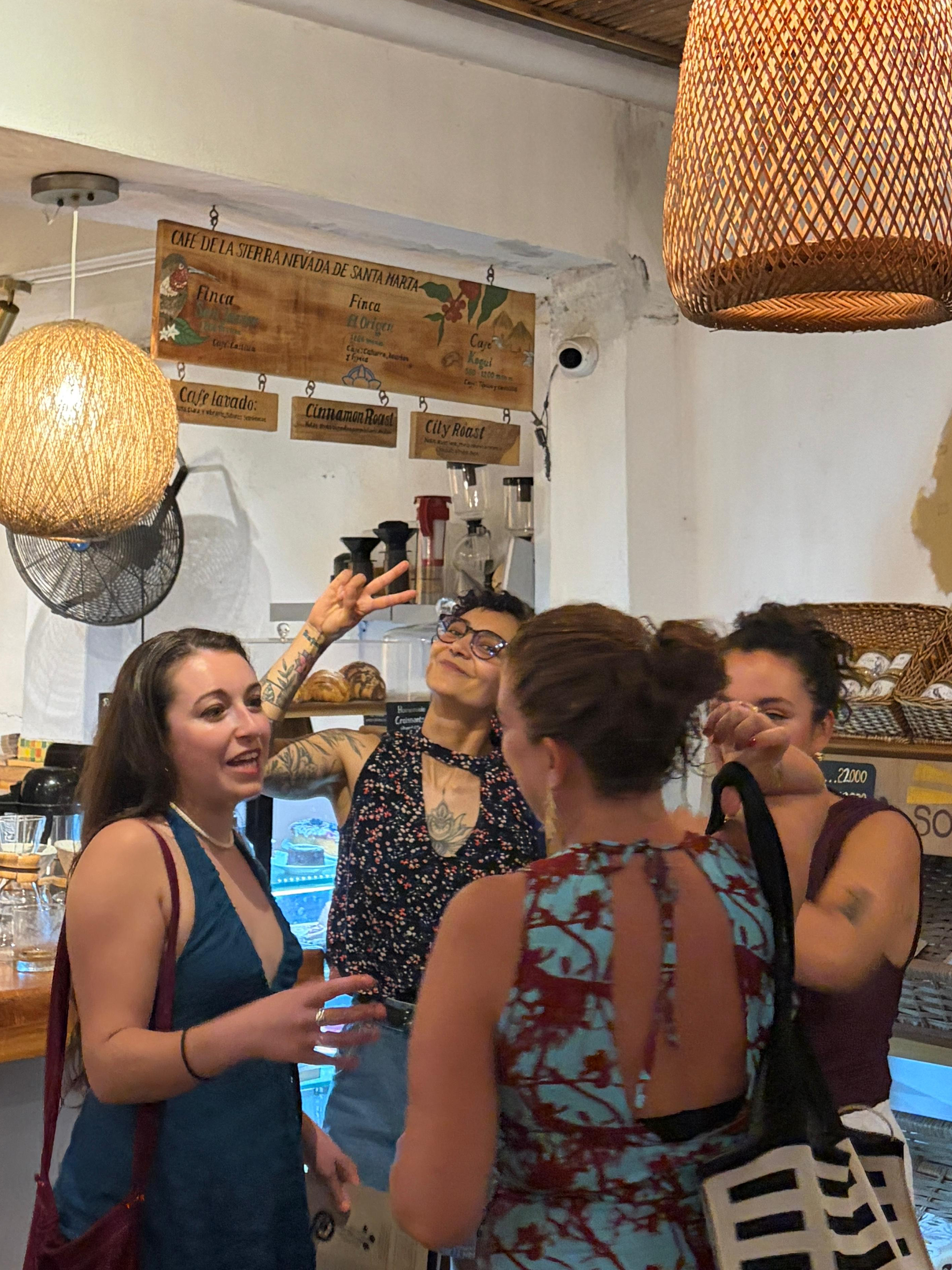
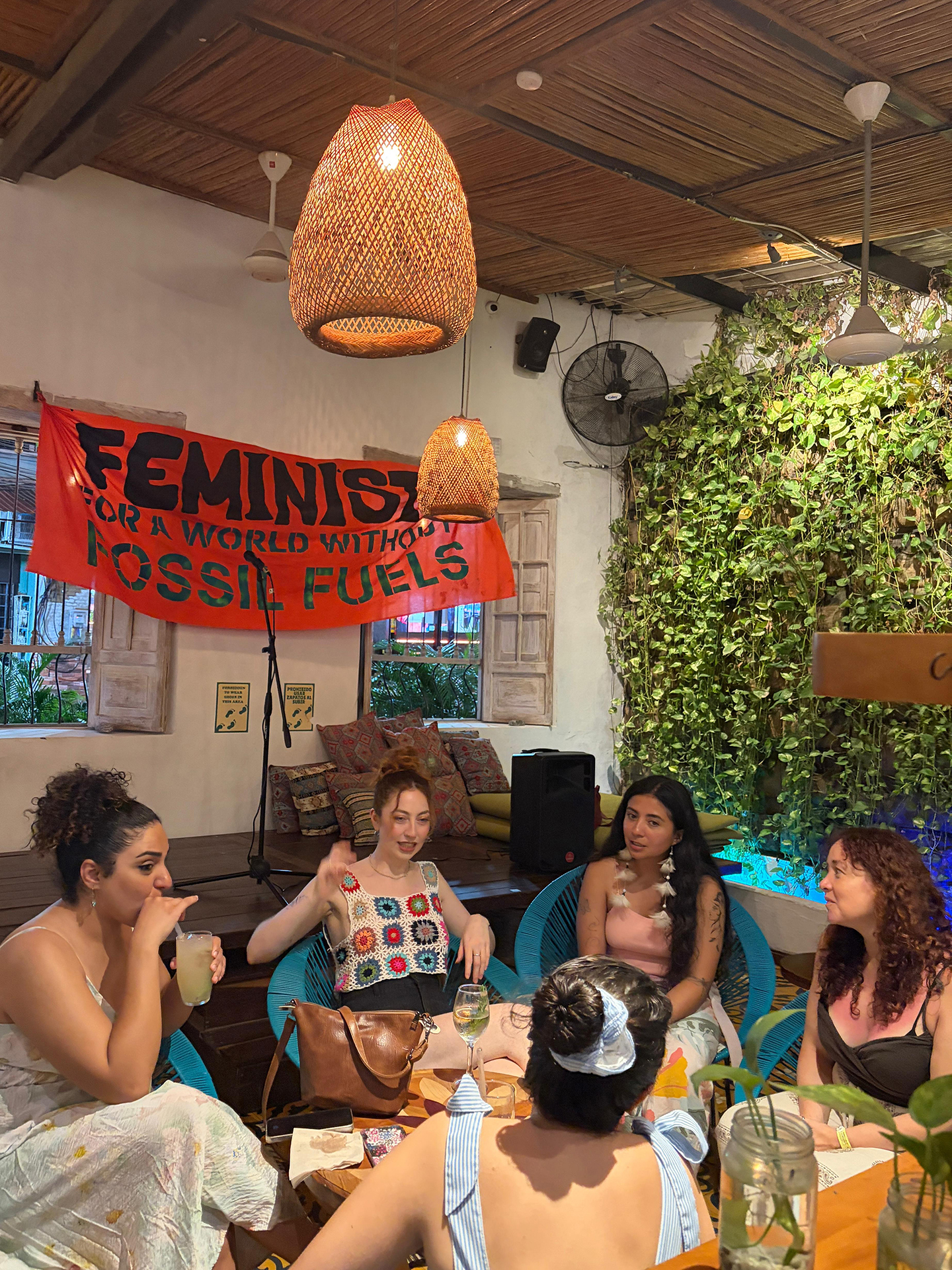
On 29 April, together with WEDO, WECF, WILPF, MENAFEM and LIMPAL Colombia, we hosted the Feminist Just Transition Mixer, a space intentionally designed for feminists and gender justice advocates to come together, connect and celebrate at the close of the Conference. After days of intense negotiations, panels and advocacy work, the Mixer offered a moment to pause, reflect and recognise the vital role that feminist movements play in advancing a just transition. It brought together activists, organisers and practitioners from across the globe, creating an atmosphere of solidarity, joy and shared purpose.


PROGRAMME OFFICER -PUBLIC SERVICES
Ana Clara works as a Programme Officer on Public Services with the Global Initiative for Economic, Social, and Cultural Rights. She holds a master’s degree in Human Rights and Humanitarian Action from Sciences Po in Paris, where she focused on economic, social, and cultural Rights, and Latin American and gender studies. She holds a Bachelor of Laws from Universidade Federal de Mato Grosso in Brazil.
Ana Clara previously worked on litigation claims concerning the right to social security and the right to health at the Public Defender’s Office and Federal Court of Justice in Brazil. She also supported the work of the Special Rapporteur on Economic, Social, Cultural, and Environmental Rights of the Inter-American Commission on Human Rights. Recently, she worked on strategic litigation before the Inter-American Court of Human Rights as part of the team of the Center for Justice and International Law.
Ana Clara, country is Brazil (Based in Paris).
PROGRAMME OFFICER -PUBLIC SERVICES & REPRESENTATIVE FOR AFRICA
Ashina works as the Programme Officer for Public Services and Representative for Africa with the Global Initiative for Economic, Social and Cultural Rights. She is an Advocate of the High Court of Kenya, with an LL.B degree from the University of Nairobi, Kenya, and an LL.M (with distinction) in Human Rights and Democratisation in Africa from the Centre for Human Rights, University of Pretoria, South Africa.
Passionate about social justice, she has worked in the human rights sector for over six years at the intersection of global and national struggles for just systems of public service delivery to ensure everyone can enjoy their socio-economic rights, first at the Economic and Social Rights Centre-Hakijamii in Kenya and then at GI-ESCR. In particular, she has led and supported research and advocacy at local, national and global research and advocacy focused on the human rights legal framework relating to the rights to land, housing, education, health and water, for marginalised communities. Her research interests also include human rights and economic policy and the contribution that human rights obligations can make to the formulation and implementation of economic policy.
Ashina is based in Nairobi, Kenya.
SENIOR COMMUNICATIONS OFFICER
Belén has a BA in International Relations. She lived in India and the Philippines just after graduating where she volunteered for three years in health and education projects. Upon her return to Argentina, where she is native from, she joined Red Solidaria as volunteer and international aid coordinator. She worked as a journalist and program manager at La Nación newspaper foundation in Buenos Aires, to later become Social Media information specialist at the US Embassy in Buenos Aires. She acted there as Liaison Officer with other sections and became Grant Officer representative. She was selected to become HelpArgentina's Executive Director to help expand fundraising opportunities abroad for NGOs from other Latin American countries, and successfully transitioned the organization into PILAS, Portal for Investment in the Latin American Social Sector. From there she moved on to working at a new media startup, RED/ACCION, as Engagement Editor and Membership coordinator before joining us as Communications Officer.
Belén is based in Buenos Aires, Argentina.
RESEARCH ASSOCIATE
Lorena Zenteno is a PhD student at the University of Edinburgh. Her primary research interests include the human rights dimensions of climate change and environmental impacts, climate change justice, gender, and the judiciary’s role in the climate change crisis. Lorena has worked for several years in Chile, as a judge, as a law clerk, in the Court of Appeal of Concepcion, Santiago and in the Constitutional Chamber of the Supreme Court of Chile. She is a member of the Environment and Human Rights Commission of the National Association of the Chilean Judiciary, dedicated to study and discuss climate change and environmental impacts on human rights. Lorena is the Chilean National Rapporteur on Global Climate Litigation database for the Sabin Center for Climate Change Law of Columbia University.
She was a senior researcher for the former UN Special Rapporteur on Cultural Rights, Karima Bennoune, from September 2018 until September 2021. Supported and assisted the UN Special Rapporteur to fulfil his mandate to the UN General Assembly and UN Human Rights Council.
She holds an LL.B. from Universidad de Concepcion, a LL.M. in Environmental Law from the University of Davis, California, and a Master in Business Law from the University Pompeu Fabra, Barcelona, Spain. Lorena is a member of the the Global Network for the Study of Human Rights and the Environment.
Lorena is based in Geneva, Swiss.
PROGRAMME OFFICER -RIGHT TO EDUCATION
Zsuzsanna works as Right to Education Officer with the Global Initiative for Economic, Social and Cultural Rights. Prior to joining GI-ESCR, she assisted in the drafting process of the Abidjan Principles on the Right to Education and the development and publication process of the Commentary of the Abidjan Principles as a consultant. Previously, she has worked with the Open Society Justice Initiative as an Aryeh Neier Fellow on issues such as equality and non-discrimination, Roma rights, the right to education, economic justice, access to justice and the rule of law. She has also worked as a lawyer with the Hungarian Civil Liberties Union on educational segregation, Roma rights and hate crimes. She holds an LL.M in Public International Law from the University of Edinburgh and a Law Degree from the Eötvös Loránd University Budapest.
Zsuzsanna is based in Budapest, Hungary.
If you enjoy our work, please consider making a donation!
No amount is too small. Your contribution will help us fight for transformative change to end endemic problems of social and economic injustice.
The Global Initiative for Economic, Social and Cultural Rights is a 501(c)(3) non-profit organisation. Donations are tax-deductible in many countries, including the United States.
OFICIAL DE PROGRAMA - SERVICIOS PÚBLICOS Y REPRESENTANTE PARA ÁFRICA
Ashina es oficial del Programa para los Servicios Públicos y Representante para África de la Global Initiative for Economic, Social and Cultural Rights. Es abogada de la Corte Suprema de Kenia, egresada (LL.B) de la Universidad de Nairobi, Kenia, y con un máster (LL.M) en derechos humanos y democratización en África, completado con honores, en el Centro para los Derechos Humanos de la Universidad de Pretoria en Sudáfrica.
Ashina es una apasionada de la justicia social, y ha trabajado en el área de los derechos humanos en el marco de las luchas nacionales y mundiales por sistemas más justos de prestación de servicios públicos, que garanticen a todos el disfrute de sus derechos socioeconómicos. Primero trabajó en el Economic and Social Rights Centre de Hakijamii, Kenia, y luego, en el GI-ESCR. Concretamente, ha dirigido y apoyado la investigación y la defensa, a nivel local, nacional y mundial, del marco legal de derechos humanos para los derechos de las comunidades marginadas a la tierra, la vivienda, la educación, la salud y el agua. Sus intereses en la investigación se orientan también a los derechos humanos y las políticas económicas, así como a la contribución que el cumplimiento de los derechos humanos hace a la formulación y ejecución de las políticas económicas.
Ashina reside en Nairobi, Kenia.
OFICIAL DE PROGRAMA - DERECHO A LA EDUCACIÓN
Zsuzsanna es oficial del Programa de Derecho a la Educación de la Global Initiative for Economic, Social and Cultural Rights. Antes de unirse a GI-ESCR, colaboró, como consultora, en la redacción de los Principios de Abiyán sobre el derecho a la educación, así como en la elaboración y publicación del Comentario de los Principios de Abiyán. Previamente, Zsuzsanna trabajó con la Open Society Justice Initiative como becaria de la Aryeh Neier Fellowship, en temas como la igualdad y la no discriminación, los derechos de los romaníes (Roma Rights), el derecho a la educación, la justicia económica, el acceso a la justicia y el estado de derecho. También ha trabajado como abogada con la Hungarian Civil Liberties en la segregación educativa, los derechos de los Romaníes y los crímenes de odio. Tiene un máster (LL.M) en derecho público Internacional por la Universidad de Edimburgo y una licenciatura en Derecho por la Universidad Eötvös Loránd, Budapest.
Zsuzsanna reside en Budapest, Hungría.
SENIOR AGENT DE COMMUNICATION
Belén est titulaire d’un BA en relations internationales. Juste après avoir obtenu son diplôme, elle a vécu en Inde et aux Philippines, où elle s'est portée volontaire pendant trois ans pour des projets de santé et d'éducation. À son retour en Argentine, d'où elle est originaire, elle a rejoint Red Solidaria en tant que volontaire et coordinatrice de l'aide internationale. Elle a travaillé comme journaliste et responsable de programme à la fondation du journal La Nación à Buenos Aires, pour devenir ensuite spécialiste de l'information sur les médias sociaux à l'ambassade des États-Unis à Buenos Aires. Elle y a joué le rôle d'agent de liaison avec les autres sections et est devenue représentante des agents de subvention. Elle a été choisie pour devenir la directrice exécutive de HelpArgentina afin d'aider à développer les possibilités de collecte de fonds à l'étranger pour les ONG d'autres pays d'Amérique latine, et a réussi la transition de l'organisation vers PILAS, le portail d'investissement dans le secteur social latino-américain. Elle a ensuite travaillé pour une start-up de nouveaux médias, RED/ACCION, en tant que rédactrice chargée de l'engagement et coordinatrice des membres, avant de nous rejoindre en tant que responsable de la communication.
Belén vit à Buenos Aires, en Argentine.
OFICIAL ASOCIADO DE PROGRAMA- SERVICIOS PÚBLICOS
Ana Clara Cathalat colabora como socia en la Global Initiative for Economic, Social, and Cultural Rights, mientras prosigue con su máster en derechos humanos y acción humanitaria en la Universidad Sciences Po, París. Allí centra su interés en los derechos económicos, sociales y culturales y en estudios de género en América Latina. Tiene una licenciatura en derecho por la Universidad Federal de Mato Grosso, Brasil.
Previamente, Ana Clara trabajó en reclamaciones judiciales relacionadas con el derecho a la seguridad social y el derecho a la salud en la Oficina del Defensor Público y el Tribunal Federal de Brasil. Asimismo, apoyó la labor del Relator Especial en Derechos Económicos, Sociales, Culturales y Ambientales de la Comisión Interamericana de Derechos Humanos. Recientemente, trabajó en litigios estratégicos ante la Corte Interamericana de Derechos Humanos, como miembro del equipo del Centro por la Justicia y el Derecho Internacional.
Ana Clara, Brasil. (Reside en París).
INVESTIGADORA ASOCIADA
Lorena Zenteno es estudiante de doctorado en la Universidad de Edimburgo. Entre sus principales intereses de investigación se encuentran el impacto del cambio climático y su efecto ambiental sobre los derechos humanos, la justicia ambiental, el género y el papel del sistema de justicia en la crisis por el cambio climático. Trabajó varios años en Chile como jueza y como asistente jurídico en la Corte de Apelaciones de Concepción, Santiago, y en la Sala Constitucional de la Corte Suprema de Chile. Es miembro de la Comisión de los Derechos Humanos y Ambientales de la Asociación Nacional de Magistrados y Magistradas de Chile, la cual se dedica a estudiar el impacto del cambio climático y su efecto ambiental sobre los derechos humanos. Lorena es la relatora nacional chilena de la base de datos de los litigios por el cambio climático del Sabin Center for Climate Change Law de la Universidad de Columbia.
Trabajó como investigadora principal para la Relatora Especial sobre los Derechos Culturales de las Naciones Unidas, Karina Bennoune, desde septiembre de 2018 hasta septiembre de 2021. Apoyó y asistió al Relator Especial de las Naciones Unidas en sus labores ante la Asamblea General y el Consejo de Derechos Humanos de las Naciones Unidas.
Tiene una licenciatura en derecho por la Universidad de Concepción, un máster en derecho ambiental por la Universidad de Davis, California, y un máster en derecho empresarial por la Universidad Pompeu Fabra en Barcelona, España. Lorena es miembro de la Global Network for the Study of Human Rights and the Environment.
Lorena reside en Ginebra, Suiza.
Si le gusta nuestro trabajo, considere hacer una donación.
Ninguna cantidad es demasiado pequeña. Su contribución nos ayudará a luchar por un cambio transformador para poner fin a los problemas endémicos de la injusticia social y económica.
La Global Initiative for Economic, Social and Cultural Rights es una organización sin fines de lucro 501(c)(3). Las donaciones son deducibles de impuestos en muchos países, incluyendo Estados Unidos.
OFICIAL DE PROGRAMA - SERVICIOS PÚBLICOS Y REPRESENTANTE PARA ÁFRICA
Ashina es oficial del Programa para los Servicios Públicos y Representante para África de la Global Initiative for Economic, Social and Cultural Rights. Es abogada de la Corte Suprema de Kenia, egresada (LL.B) de la Universidad de Nairobi, Kenia, y con un máster (LL.M) en derechos humanos y democratización en África, completado con honores, en el Centro para los Derechos Humanos de la Universidad de Pretoria en Sudáfrica.
Ashina es una apasionada de la justicia social, y ha trabajado en el área de los derechos humanos en el marco de las luchas nacionales y mundiales por sistemas más justos de prestación de servicios públicos, que garanticen a todos el disfrute de sus derechos socioeconómicos. Primero trabajó en el Economic and Social Rights Centre de Hakijamii, Kenia, y luego, en el GI-ESCR. Concretamente, ha dirigido y apoyado la investigación y la defensa, a nivel local, nacional y mundial, del marco legal de derechos humanos para los derechos de las comunidades marginadas a la tierra, la vivienda, la educación, la salud y el agua. Sus intereses en la investigación se orientan también a los derechos humanos y las políticas económicas, así como a la contribución que el cumplimiento de los derechos humanos hace a la formulación y ejecución de las políticas económicas.
Ashina reside en Nairobi, Kenia.
RESPONSABLE DE PROGRAMME - DROIT À l’ÉDUCATION
Zsuzsanna travaille actuellement en tant que responsable du droit à l'éducation pour l'Initiative mondiale pour les droits économiques, sociaux et culturels. Avant de rejoindre GI-ESCR, elle a participé, en tant que consultante, au processus de rédaction des Principes d'Abidjan sur le droit à l'éducation et au développement et à la publication du Commentaire des Principes d'Abidjan. Auparavant, elle a travaillé avec l'Open Society Justice Initiative en tant que boursière Aryeh Neier sur des questions telles que l'égalité et la non-discrimination, les droits des Roms, le droit à l'éducation, la justice économique, l'accès à la justice et l'État de droit. Elle a également travaillé en tant qu'avocate pour l'Union hongroise des libertés civiles sur la ségrégation scolaire, les droits des Roms et les crimes haineux. Elle est titulaire d'un master en droit international public de l'Université d'Édimbourg et d'un diplôme de droit de l'Université Eötvös Loránd de Budapest.
Zsuzsanna vit à Budapest, en Hongrie.
CHARGÉE DE PROGRAMME ASSOCIÉE – SERVICES PUBLICS
Ana Clara Cathalat collabore actuellement, dans le cadre d’une bourse, à l’Initiative mondiale pour les droits économiques, sociaux et culturels, tout en préparant un master en droits de l'Homme et action humanitaire à Sciences Po Paris, où elle se spécialise en droits économiques, sociaux et culturels, ainsi qu’en études de genre et latino-américaines. Elle a une licence de droit de l’Université Fédérale du Mato Grosso au Brésil.
Ana Clara a auparavant travaillé sur des actions en justice relatives au droit à la sécurité sociale et au droit à la santé auprès du Bureau de l’aide juridictionnelle et de la Cour de justice fédérale du Brésil. Elle a également appuyé les travaux de la Rapporteuse spéciale sur les droits économiques, sociaux, culturels et environnementaux de la Commission interaméricaine des droits de l'Homme. Elle a récemment travaillé sur des actions en justice dans des cas stratégiques auprès de la Cour interaméricaine des droits de l'Homme, au sein de l’équipe du Centre pour la Justice et le Droit International (CEJIL).
Ana Clara, le pays est le Brésil (Basée à Paris).
ASSOCIÉE DE RECHERCHE
Lorena Zenteno est doctorante à l’Université d’Édimbourg. Ses principaux thèmes de recherche sont les dimensions du changement climatique et des problèmes écologiques relatives aux droits de l'Homme, la justice climatique, le genre, et le rôle de la Justice dans la crise du changement climatique. Lorena a travaillé pendant plusieurs années au Chili, comme juge et comme légiste, auprès des Cours d’appel de Concepción et Santiago et de la Chambre constitutionnelle de la Cour suprême du Chili. Elle fait partie de la Commission de l’environnement et des droits de l'Homme de l’Association nationale de la magistrature chilienne, dont la mission est d’étudier et de débattre des conséquences du changement climatique et des problèmes écologiques sur les droits de l'Homme. Lorena est la Rapporteuse nationale chilienne sur la base mondiale des actions en justice climatiques pour le Centre Sabin pour le droit du changement climatique de l’Université de Columbia.
Elle a occupé le rôle de chercheuse principale pour l’ancienne Rapporteuse spéciale sur les droits culturels de l’ONU, Karima Bennoune, entre septembre 2018 et septembre 2021. Elle a appuyé et soutenu la Rapporteuse spéciale de l’ONU dans l’accomplissement de son mandat conféré par l’Assemblée générale de l’ONU et le Conseil des droits de l'Homme de l’ONU.
Elle a une licence de droit de l’Université de Concepción, un master en droit de l’environnement de l’Université de Davis (California) et un master en droit des affaires de l’Université Pompeu Fabra de Barcelone (Espagne). Lorena fait partie du Réseau mondiale pour l’étude des droits de l'Homme et de l’environnement.
Lorena vit à le Chili, basé à Genève.
Si vous aimez notre travail, pensez à faire un don !
Aucun montant n'est trop petit. Votre contribution nous aidera à lutter pour un changement transformateur afin de mettre fin aux problèmes endémiques d'injustice sociale et économique.
L'Initiative mondiale pour les droits économiques, sociaux et culturels est une organisation à but non lucratif 501(c)(3). Les dons sont déductibles des impôts dans de nombreux pays, y compris aux États-Unis.
SENIOR OFICIAL DE COMUNICACIONES
Belén es licenciada en Relaciones Internacionales. Apenas se graduó, vivió en la India y en Filipinas, donde fue voluntaria durante tres años en proyectos de salud y educación. Al regresar a su nativa Argentina se incorporó a la Red Solidaria como voluntaria y coordinadora de ayuda internacional. Trabajó como periodista y gestora de programas de la fundación del diario La Nación en Buenos Aires, para luego convertirse en especialista en información de medios sociales en la Embajada de Estados Unidos en Buenos Aires. Allí actuó como oficial de enlace con otras secciones y se convirtió en oficial representante de los programas de subvenciones. Fue seleccionada como Directora Ejecutiva de HelpArgentina con la función de ampliar las oportunidades de recaudación de fondos internacionales de las ONG de otros países latinoamericanos, y logró la transición exitosa de la organización hacia PILAS, Portal para la Inversión Social en Latinoamérica. De allí pasó a trabajar en una nueva empresa de medios de comunicación, RED/ACCION, como editora y coordinadora de membresías, antes de unirse al equipo de la GI-ESCR como oficial de comunicaciones.
Belén reside en Buenos Aires, Argentina.
DIRECTORA EJECUTIVA
Camila cuenta con más de 14 años de experiencia en abogacía a niveles nacional, regional y multilateral, especializándose en la supervisión de investigaciones y litigios sobre diversos temas de derechos humanos. Ha residido en Buenos Aires, donde trabajó en el Centro de Estudios Legales y Sociales (CELS), coordinando esfuerzos internacionales durante cuatro años. Camila posee una maestría en Administración Pública y Política Pública de la Fundación Getulio Vargas en San Pablo y una licenciatura en Relaciones Internacionales de la Universidad de Brasilia.
Camila reside en Brasilia, Brasil.
.