
LA JURISPRUDENCE DU COMITÉ DES DROITS ÉCONOMIQUES, SOCIAUX ET CULTURELS
Le Comité des droits économiques, sociaux et culturels des Nations Unies est un organe d'experts des droits de l'homme mandaté pour surveiller la mise en œuvre par les États du Pacte international relatif aux droits économiques, sociaux et culturels (PIDESC). En vertu du Protocole facultatif au PIDESC, le Comité peut examiner des plaintes individuelles alléguant qu'un État partie au Protocole facultatif a violé un droit garanti par le Pacte. Pour une explication de ce processus et des différents types de décision que le Comité peut rendre, voir le Guide du processus de communication individuelle du GI-DESC.
Le Comité a rendu un total de 73 décisions, dont 10 décisions sur le fond, 20 décisions d'irrecevabilité et 43 décisions de désistement. Sur cette page, vous pouvez trouver :
- Un résumé de chacune des communications que le Comité a décidé
- Une base de données avec des statistiques sur toutes les décisions du Comité
- Une analyse des tendances les plus significatives qui ressortent de la jurisprudence du Comité
La page a été mise à jour pour la dernière fois le 26 avril 2021.
RÉSUMÉ DES DÉCISIONS DU COMITÉ
Décisions sur le fond
Décisions d'irrecevabilité
Décisions de désistement
Deisy Karina Gómez Torres v Spain
A.S.M.C. v Spain
J.G.L. et al. v Spain
BASE DE DONNÉES DES COMMUNICATIONS INDIVIDUELLES
Au GI-ESCR, nous avons suivi la jurisprudence du Comité en vertu du Protocole facultatif et collecté des informations sur les communications qu'il a déterminées.
Une feuille de calcul Excel contenant ces données est accessible ici.
La feuille de calcul peut être utilisée pour trier les communications selon des filtres tels que les problèmes de recevabilité soulevés, le droit concerné ou si l'auteur était représenté par un avocat.
La feuille de calcul a été mise à jour pour la dernière fois le 19 avril 2021.
Une feuille de calcul Excel contenant ces données est accessible ici.
La feuille de calcul peut être utilisée pour trier les communications selon des filtres tels que les problèmes de recevabilité soulevés, le droit concerné ou si l'auteur était représenté par un avocat.
La feuille de calcul a été mise à jour pour la dernière fois le 19 avril 2021.

TENDANCES DANS LA JURISPRUDENCE DU COMITÉ
Ci-dessous, nous présentons et analysons quelques-unes des tendances les plus significatives qui se sont dégagées des décisions du Comité.
L'ÉVOLUTION DE LA CHARGE DE TRAVAIL DU COMITÉ
À l'heure actuelle, il faut en moyenne au Comité 21 mois à compter de la date d'enregistrement d'une communication pour prendre une décision d'irrecevabilité et 26 mois pour prendre une décision au fond.
Au cours des cinq premières années suivant l'entrée en vigueur du Protocole facultatif, le Comité a enregistré moins de 8 nouveaux cas chaque année (2013-2017). Cela a radicalement changé en 2018, le Comité ayant enregistré un total de 67 nouvelles communications, suivies de 84 autres en 2019. En 2020, le nombre de communications enregistrées est tombé à 24, peut-être en raison des moratoires sur les expulsions qui ont été introduits par les États en le contexte de la pandémie de coronavirus. La dernière mise à jour du site Web du Comité montre que seuls 8 cas ont jusqu'à présent été enregistrés en 2021.
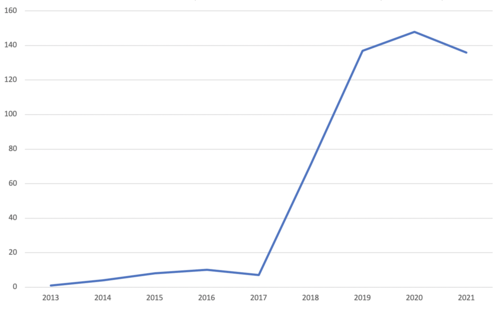
Arriéré du CESCR, mesuré par le nombre total de communications en attente.
Veuillez noter que ces graphiques visent à montrer les tendances générales de la charge de travail du Comité. Il peut y avoir des inexactitudes mineures concernant le nombre exact d'affaires enregistrées, tranchées et pendantes.
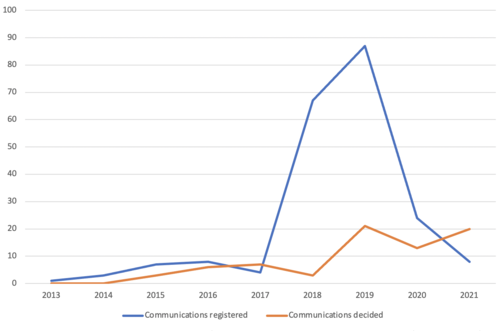
Communications CESCR enregistrées et déterminées chaque année
Comme on peut le voir sur le graphique ci-dessus, le Comité statue maintenant sur plus de communications qu'il ne le faisait dans les premières années de ses fonctions en vertu du Protocole facultatif. En effet, après avoir réduit l'écart entre les communications enregistrées et décidées en 2020, il est possible que 2021 soit la première année depuis 2017 au cours de laquelle le Comité statue sur plus d'affaires qu'il n'en enregistre.
Le fait que le nombre de communications enregistrées ait largement dépassé le nombre décidé en 2018 et 2019 signifie que le Comité a encore un important arriéré d'affaires à régler. Le Comité étudie actuellement des moyens novateurs de s'adapter pour faire face à cet arriéré. Par exemple, dans son projet de règlement intérieur en vertu du Protocole facultatif, le Comité a proposé d'introduire une procédure d'avis pilote de nature similaire à la procédure d'arrêt pilote de la Cour européenne des droits de l'homme (voir règle 20).
QUELS DROITS ONT ÉTÉ
LE PLUS INVOQUÉS?
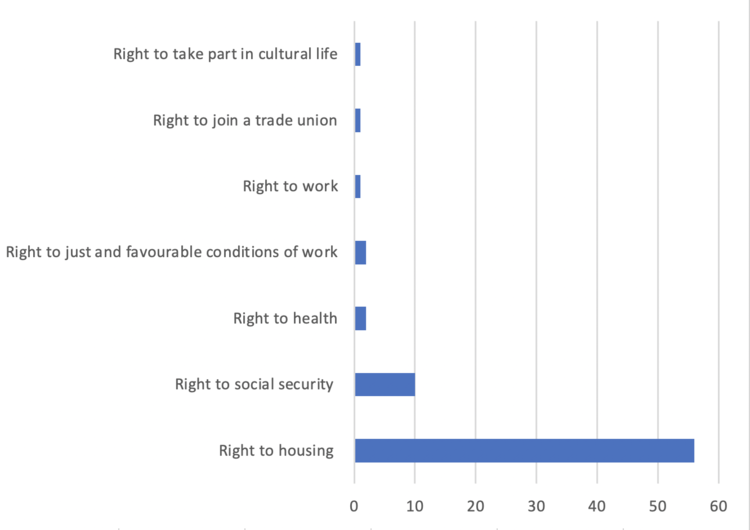
Décisions du CESCR selon le droit primaire qu'elles concernent
Dans la grande majorité des affaires tranchées par le Comité, le demandeur individuel alléguait une violation du droit à un logement convenable (56 décisions sur 73). L'Espagne était l'État partie défendeur dans toutes ces affaires, dont plus de 75 % ont abouti à une décision de non-lieu.
Dans nombre de ces cas, le plaignant a demandé au Comité de demander des mesures provisoires, une mesure qui est particulièrement importante dans les situations où les individus sont confrontés à la violation potentielle de leurs droits par une expulsion. La volonté du Comité de demander des mesures provisoires peut être considérée comme l'un des facteurs à l'origine du grand nombre de plaintes concernant le droit à un logement convenable. Par exemple, des mesures provisoires ont été accordées dans toutes les 16 communications sur le droit au logement, sauf une, qui ont été interrompues par le Comité lors de sa 69e session (2021).
Le Comité a également examiné dix cas dans lesquels le plaignant a allégué une violation du droit à la sécurité sociale, bien qu'ayant déclaré huit de ces cas irrecevables, il n'ait pas développé beaucoup de jurisprudence sur le fond du droit lui-même. Sept des affaires irrecevables étaient de nature presque identique, ayant toutes été introduites par d'anciens employés d'une banque espagnole qui avaient perdu leur droit à bénéficier d'une politique de retraite lors de la cessation de leur emploi (A.C.G. et al fournit un exemple représentatif). L'autre communication irrecevable, Arellano Medina, concernait les dispositifs de sécurité sociale en Equateur. Le Comité a rendu une décision au fond dans l'affaire Miguel Ángel López Rodríguez, mais a déterminé que la réduction par l'Espagne de la pension d'invalidité d'un détenu ne constituait pas une violation du Pacte. Trujillo Calero est le seul cas dans lequel le Comité a établi qu'une violation du droit à la sécurité sociale a eu lieu.
Une prétendue violation du droit à la santé a constitué la base de deux communications, dont l'une a été déclarée irrecevable (Merino Sierra et al) et l'autre qui a abouti à la constatation d'une violation du Pacte (S. C. et G. P., qui concernait des in vitro fertilisation).
Le droit à des conditions de travail justes et favorables a été le principal droit concerné dans deux affaires, toutes deux déclarées irrecevables (Martins Coelho, Luciano Daniel Juárez). Il y a actuellement deux communications sur la liste des affaires pendantes du Comité qui concernent le droit à des conditions de travail justes et favorables, toutes deux adressées à la France. À ce titre, il est possible que le Comité commence à développer sa jurisprudence sur ce droit dans un proche avenir.
Le droit au travail, le droit d'adhérer à un syndicat et le droit de participer à la vie culturelle ont été les principaux droits invoqués dans une affaire chacun (respectivement, Arellano Medina, M. L. B. et A.M.B.). Les trois affaires ayant été déclarées irrecevables, le Comité n'a pas eu la possibilité de se livrer à une interprétation substantielle de leur contenu.
QUELS ÉTATS PARTIES
SONT CONCERNÉS DES CAS ?
Comme le montre le graphique de droite, l'Espagne a été l'État partie défendeur dans l'écrasante majorité des affaires du Comité (65 sur 73).
Cette tendance devrait se poursuivre, avec 132 des 139 affaires pendantes du Comité adressées à l'Espagne, toutes sauf une concernant le droit à un logement convenable. Il convient toutefois de noter que ce n'est que dans six cas que le Comité a conclu que l'Espagne avait enfreint le PIDESC (I.D.G ; Ben Djazia et al ; López Albán et al ; Gómez-Limón Pardo ; El Goumari et Tidli ; et El Ayoubi et El Azouan Azouz).
La prédominance des cas de logement espagnols pourrait s'expliquer par l'interaction de deux facteurs clés:
Cette tendance devrait se poursuivre, avec 132 des 139 affaires pendantes du Comité adressées à l'Espagne, toutes sauf une concernant le droit à un logement convenable. Il convient toutefois de noter que ce n'est que dans six cas que le Comité a conclu que l'Espagne avait enfreint le PIDESC (I.D.G ; Ben Djazia et al ; López Albán et al ; Gómez-Limón Pardo ; El Goumari et Tidli ; et El Ayoubi et El Azouan Azouz).
La prédominance des cas de logement espagnols pourrait s'expliquer par l'interaction de deux facteurs clés:
- Tout d'abord, à la suite de la crise financière, l'Espagne a connu une grave crise du logement qui a laissé de nombreuses personnes dans une situation de logement vulnérable. Comme décrit ci-dessus, le pouvoir du Comité de demander des mesures provisoires en fait un forum particulièrement important pour garantir les droits des individus dans ce contexte.
Deuxièmement, en 2018, la Cour suprême espagnole a déterminé que les décisions individuelles des organes de traités des Nations Unies étaient juridiquement contraignantes, augmentant considérablement l'attractivité du CESCR en tant que forum de règlement des différends.
L'Équateur occupe une lointaine deuxième place dans le tableau des États qui ont été concernés par les décisions du Comité, avec un total de quatre communications. L'Italie, le Portugal, le Luxembourg et l'Argentine ont chacun fait l'objet d'une des décisions du Comité.
Outre l'Espagne, des communications contre la France, la Belgique, l'Argentine et l'Uruguay sont en attente sur la liste des affaires pendantes du Comité.
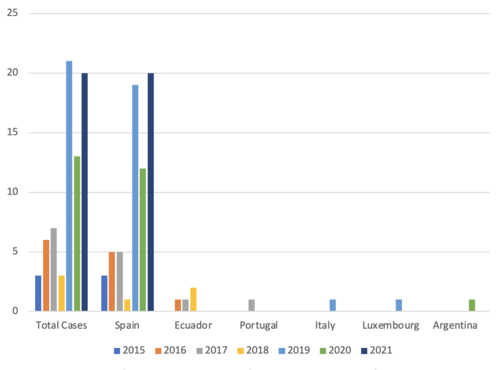
Décisions du CESCR par l'État partie défendeur
QUEL TYPE DE DÉCISIONS LE CESCR PREND-IL LE PLUS SOUVENT?
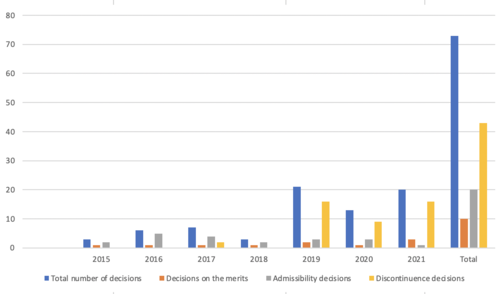
Décisions du CESCR par type
En avril 2021, le Comité avait rendu un total de 73 décisions.
Plus de la moitié d'entre elles (43) étaient des décisions d'interrompre les communications, souvent du fait que le plaignant avait trouvé une solution satisfaisante au problème qui l'avait poussé à soumettre une communication au CESCR (voir, par exemple, le cas de Elisabet Posada Pérez et al).
Lors de la 69e session la plus récente, plus de la moitié des 16 décisions de désistement ont été demandées par les auteurs eux-mêmes.
Le Comité a également déclaré 20 communications irrecevables en totalité (non compris les déclarations d'irrecevabilité partielle).
La raison la plus courante pour laquelle une communication est déclarée irrecevable dans son intégralité est simplement que le Comité n'est pas compétent ratione temporis pour l'entendre, étant donné que les événements qui font l'objet d'une communication se sont produits avant l'entrée en vigueur du Protocole facultatif pour l'État en question (art. 3 (2) (b) OP-ICESCR). Cela s'est produit à neuf reprises, sept en relation avec l'ensemble des affaires de sécurité sociale espagnoles presque identiques (comme l'affaire L.A.M.C.), une en relation avec une affaire espagnole sur le droit à la santé (Merino Sierra) et une en matière sociale. affaire de sécurité contre l'Équateur (Alarcón Flores et al). Toutes ces communications ont cependant été décidées avant 2018. Ces dernières années, les communications sont plus susceptibles d'être déclarées irrecevables pour non-épuisement des voies de recours internes (article 3 (1) OP-ICESCR) ou pour insuffisance de justifications (article 3 (2) (e) OP-ICESCR).
Enfin, le Comité a examiné un total de 10 cas sur le fond. Elle a constaté une violation du Pacte dans toutes ces affaires, sauf deux (Miguel Ángel López Rodríguez ; Soraya Moreno Romero), ce qui signifie qu'une violation du Pacte est constatée dans 80 % des cas qui dépassent l'étape de la recevabilité. Cela peut être considéré à la fois comme un témoignage de la difficulté de satisfaire aux critères de recevabilité rigoureux et comme un appel aux conseils pour qu'ils se familiarisent avec les normes du Comité.
