Accessibility Tools

Select your language

The Jurisprudence Of The Committee On Economic, Social And Cultural Rights

The United Nations Committee on Economic, Social and Cultural Rights is a body of human rights experts mandated to monitor State implementation of the International Covenant on Economic, Social and Cultural Rights (ICESCR). Under the Optional Protocol to the ICESCR the Committee may consider individual complaints that a State Party to the Optional Protocol has violated a Covenant right. For an explanation of this process and the different types of decision that the Committee can deliver, see GI-ESCR’s Guide to the Individual Communication Process.

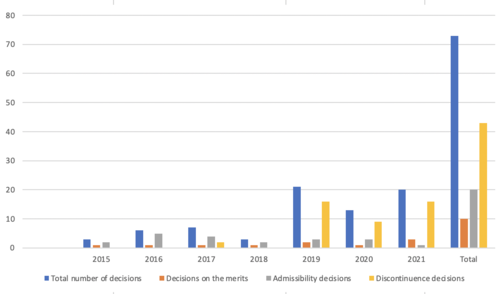
The Committee has delivered a total of 73 decisions, including 10 decisions on the merits, 20 inadmissibility decisions and 43 discontinuance decisions. On this page, you can find:

 The page was last updated on 26th April 2021.

SUMMARIES OF COMMITTEE DECISIONS

Decisions on the merits

Discontinuance decisions

Deisy Karina Gómez Torres v Spain

A.S.M.C. v Spain

J.G.L. et al. v Spain

DATABASE OF INDIVIDUAL COMMUNICATIONS

At GI-ESCR, we have been tracking the Committee’s jurisprudence under the Optional Protocol and collecting information on the communications that it has determined. 

An excel spreadsheet containing this data may be accessed here. 

The spreadsheet can be used to sort communications according to filters such as the admissibility issues raised, the right concerned, or whether the author was represented by legal counsel. 

The spreadsheet was last updated on 19th April 2021.

Image

TRENDS IN THE COMMITTEE’S JURISPRUDENCE

Below, we present and analyse several of the most significant trends that have emerged from the Committee’s decisions.

THE EVOLVING WORKLOAD OF THE COMMITTEE

At present, it takes the Committee an average of 21 months from the date that a communication is registered to make an inadmissibility decision, and 26 months to make a merits decision.

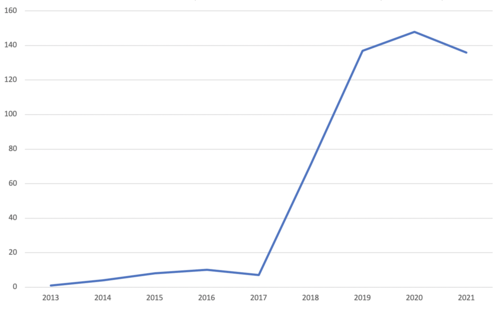
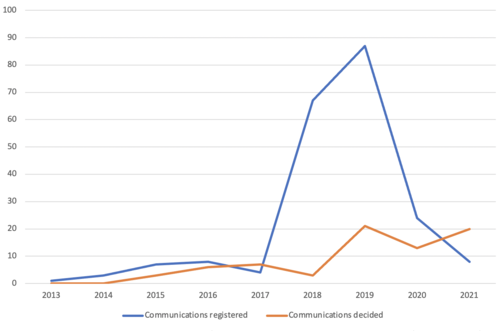
In the first five years following the entry into force of the Optional Protocol the Committee registered less than 8 new cases each year (2013 – 2017). This changed drastically in 2018 as the Committee registered a total of 67 new communications, followed by an additional 84 in 2019. In 2020 the number of registered communications fell back to 24, possibly as a consequence of eviction moratoria that have been introduced by States in the context of the coronavirus pandemic. The latest update to the Committee’s website shows that only 8 cases have thus far been registered in 2021.
Image
CESCR backlog, as measured by the total number of communications pending.

Please note that these graphs are intended to show general trends in the Committee's workload. There may be minor inaccuracies in relation to the exact number of cases registered, decided and pending.
Image
CESCR communications registered and determined each year

As can be seen from the graph above, the Committee now decides more communications than it did in the early years of its functions under the Optional Protocol. Indeed, after narrowing the gap between communications registered and decided in 2020, it is possible that 2021 may be the first year since 2017 in which the Committee decides more cases than it registers.

The fact that the number of communications registered far exceeded the number decided in 2018 and 2019 means that the Committee still has a significant backlog of cases to clear. The Committee is currently considering innovative ways in which it can adapt to deal with this backlog. For example, in its Draft Rules of Procedure under the Optional Protocol, the Committee has proposed to introduce a Pilot Views procedure that is similar in nature to the Pilot Judgment Procedure of the European Court Human Rights (see Rule 20).

WHICH RIGHTS HAVE BEEN
INVOKED THE MOST?
Image
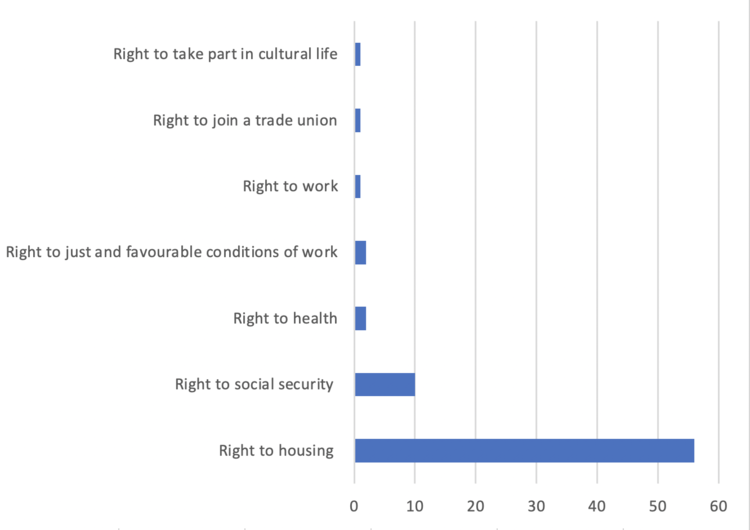
CESCR decisions according to the primary right that they concern

In the vast majority of cases decided by the Committee, the individual claimant alleged a violation of the right to adequate housing (56 of 73 decisions). Spain was the respondent State Party in all of these cases, over 75% of which resulted in a discontinuance decision.

In many of these cases the complainant asked the Committee to request interim measures, a measure that is particularly important in situations where individuals face the potential violation of their rights through an eviction. The Committee’s willingness to request interim measures may be considered one of the factors driving the large number of complaints that concern the right to adequate housing. For example, interim measures were granted in all but one of the 16 right to housing communications that were discontinued by the Committee in its 69th session (2021).

The Committee has also considered ten cases in which the complainant has alleged a violation of the right to social security, although as it declared eight of these cases inadmissible it has not developed a great deal of jurisprudence on the substance of the right itself. Seven of the inadmissible cases were nearly identical in nature, having all been brought by former employees of a Spanish bank who had lost their right to benefit from a pension policy when their employment was terminated (A.C.G. et al provides a representative example). The other inadmissible communication, Arellano Medina, concerned social security arrangements in Ecuador. The Committee reached a merits decision in the case of Miguel Ángel López Rodríguez, yet determined that Spain’s reduction of a prisoner’s disability benefit did not constitute a violation of the Covenant. Trujillo Calero is the sole case in which the Committee has established that a violation of the right to social security took place.

An alleged violation of the right to health has formed the basis of two communications, one of which was declared inadmissible (Merino Sierra et al) and one which resulted in a determination that the Covenant had been violated (S. C. and G. P., which concerned in vitro fertilisation).

The right to just and favourable conditions of work has been the primary right concerned in two cases, both of which were declared inadmissible (Martins Coelho, Luciano Daniel Juárez). There are currently two communications on the Committee’s list of pending cases which concern the right to just and favourable conditions of work, both of which are addressed to France. As such, it is possible that the Committee will begin to develop its jurisprudence on this right in the near future.

The right to work, the right to join a trade union and the right to take part in cultural life were the primary rights invoked in one case each (respectively, Arellano Medina, M. L. B. and A.M.B.). As all three cases were found to be inadmissible the Committee did not have the opportunity to engage in a substantive interpretation of their content.

WHICH STATE PARTIES
HAVE CASES CONCERNED?

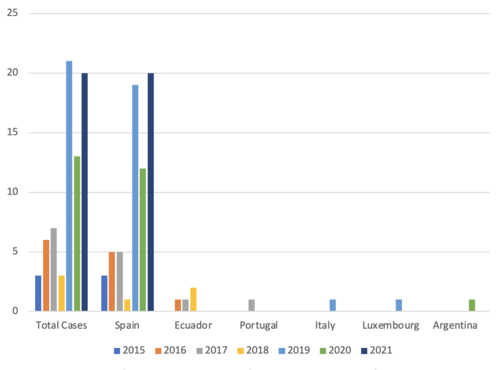
As can be seen from the graph on the right, Spain has been the respondent State party in the overwhelming majority of the Committee’s cases (65 out of 73).

This trend looks set to continue, with 132 of the Committee’s 139 pending cases addressed to Spain, all but one of which concern the right to adequate housing. It is worth noting, however that it is only in six cases that the Committee has found Spain to be in violation of the ICESCR (I.D.G; Ben Djazia et al; López Albán et al; Gómez-Limón Pardo; El Goumari and Tidli; and El Ayoubi and El Azouan Azouz).

The predominance of Spanish housing cases could be explained by the interplay of two key factors:

Ecuador occupies a distant second place in the table of States that have been concerned by the Committee’s decisions, with a total of four communications. Italy, Portugal, Luxembourg and Argentina have each been the subject of one of the Committee’s decisions.  

Aside from Spain, communications against France, Belgium, Argentina and Uruguay lie in wait on the Committee’s list of pending cases.
Image
CESCR Decisions by Respondent State Party

WHAT TYPE OF DECISIONS DO
THE CESCR MAKE MOST OFTEN?
Image
CESCR Decisions by Type

As of April 2021, the Committee has delivered a total of 73 decisions.

Over half of these (43) were decisions to discontinue communications, often as a result of the fact that the complainant had found a satisfactory solution to the problem which drove them to submit a communication to the CESCR (see, for example, the case of Elisabet Posada Pérez et al).

In the most recent 69th session, over half of the 16 discontinuance decisions were requested by the authors themselves.

The Committee has also declared 20 communications to be inadmissible in full (not including declarations of partial inadmissibility).

The most common reason for a communication being declared inadmissible in full is simply that the Committee is not competent ratione temporis to hear it, as the events that form the subject of a communication occurred prior to the entry into force of the Optional Protocol for the State in question (art. 3 (2) (b) OP-ICESCR). This has occurred on nine occasions, seven in relation to the set of near identical Spanish social security cases (such as the case of L.A.M.C.), one in relation to a Spanish case on the right to health (Merino Sierra) and one in a social security case against Ecuador (Alarcón Flores et al). All of these communications were decided before 2018, however. In recent years, communications are more likely to be declared inadmissible for failure to exhaust domestic remedies (article 3 (1) OP-ICESCR) or for insufficient substantiation (article 3 (2) (e) OP-ICESCR).

Finally, the Committee has considered a total of 10 cases on the merits. It has found a violation of the Covenant in all of these cases, bar two (Miguel Ángel López Rodríguez; Soraya Moreno Romero), meaning that a violation of the Covenant is found in 80% of cases that make it past the admissibility stage. This may be considered as both a testament to the difficulty of passing the stringent admissibility criteria and a plea to counsel to ensure that they familiarise themselves with the Committee’s standards.

NEWSLETTER

Don´t miss any updates!
Image

Select your language

Social Media:

Log in

Climate and Environmental Justice

We have advanced rights-based and gender-transformative transition frameworks through research that centres the lived experiences of women and marginalised communities on the frontlines of extractive energy policies, promoting climate and energy frameworks attentive to the social and care-related impacts of transition pathways. We have developed a clear vision for a gender-just transition, firmly rooted in gender and human rights norms, establishing both the legal basis and the direction for the transformative changes our planet and societies urgently need. In particular, the ‘Guiding Principles for Gender Equality and Human Rights in the Energy Transition’, a collective effort built through online consultations, an in-person workshop and multiple rounds of revision with activists, practitioners and experts from around the world, outline a transformative vision for reshaping global energy systems through a human rights and gender equality lens.

Our work recognises that the climate emergency is both an existential threat and an opportunity to reimagine societies built on social, gender, economic and environmental justice. We ground our advocacy in feminist and intersectional principles, prioritising the agency and perspectives of communities in the Global South who have contributed the least to the climate emergency yet face its most devastating consequences. Central to our approach is the understanding that energy is not merely a commodity but a fundamental human right; essential for dignity, health, education, work and the realisation of countless other rights. We challenge approaches to the energy transition that risk replicating the harmful patterns of fossil fuel extraction and, instead, advocate for transformative policies that ensure human rights and gender equality as central to building climate-resilient societies rooted in dignity, justice and planetary well-being.

What's next?

We will continue to challenge approaches that treat energy transition as merely a technical shift, instead positioning it as an opportunity to reimagine economies and societies rooted in dignity for all, with particular attention to communities in the Global South who have contributed least to the climate emergency yet are most exposed to its worst effects.

We will connect community-level evidence and the lived experiences of those on the frontlines of extractive policies to national reform and global norm-setting, breaking down silos between human rights, gender, and climate movements, and advancing a shared vision that recognises just transitions as not only fundamental to achieving climate-resilient and sustainable societies, but as transformative pathways that advance social and gender equality, redistribute power and resources equitably, and ensure that energy systems serve the public good rather than profit.

We will mainstream rights-based and genderjust transition priorities in key multilateral spaces (particularly, within the Just Transition Work Programme and the to-be-developed Just Transition Mechanism, within the UNFCCC) to guarantee that just transitions are advanced at all levels.

We will also translate our work, through strategic advocacy, into at least two concrete policy wins, whether promoted, adopted, implemented, or scaled, in priority countries (Argentina, Brazil, Chile, Mexico, Colombia, South Africa, or Kenya), ensuring these policies align with human rights standards, centre gender equality, and reflect the needs and views of affected communities.

We will build momentum for the progressive recognition of the right to sustainable energy to shift dominant narratives away from purely extractive solutions that sideline gendered impacts, community participation, and Global South perspectives.

Economic Justice and Climate Finance

Our work has transformed the global discussion on fiscal policy in a more just, emancipatory and sustainable direction. Our approach has combined both high-level, expert contributions within decisionmaking circles, with bold, impactful work on narrative change with the general public.

We have been instrumental in the inclusion of human rights as a guiding principle of the future United Nations Framework Convention on International Tax Cooperation, a multilateral instrument with the potential of raising approx. USD 492 billion per year in public revenues currently foregone to global tax abuse. In the process leading to the ‘Compromiso de Sevilla’ decided at FfD4, we proposed and succeeded in creating a specific human rights workstream within the Civil Society Financing for Development Mechanism, which was critical to ensure that explicit commitments on the matter were included in the negotiating outcome. In a context of cutbacks in multilateral institutions, we have amplified the capacities of technical experts, providing rigorous technical support and leveraging our influence to ensure the enactments of groundbreaking standard-setting instruments, such as the 2025 UN Committee on Economic, Social and Cultural Rights Statement on Fiscal Policy and Human Rights, and the first ex oficio hearing on the Inter-American Commission of Human Rights on Fiscal and Economic Policies to Address Poverty and Structural Inequality, leading to an upcoming thematic resolution on the matter. We have also bridged the silos between multilateral tax discussions and climate finance debates, promoting ambitious financing commitments to increase international and domestic resource mobilisation during COP 28, 29 and 30.

At the regional level, our engagement with fiscal cooperation platforms such as the Platform for Fiscal Cooperation of Latin America and the Caribbean (PTLAC), where we are member of its Civil Society Consultative Council, and the African Anti-IFFs Policy Tracker, for which we participated in the pilot mission in Ivory Coast together with Tax Justice Network Africa (TJNA), have been critical in cementing a growing engagement between tax administrations and ministries of finance with international legal experts, exploring actionable and transformative initiatives, such as the taxation of high-net-worth individuals, beneficial ownership registries and corporate countryby-country reports, to be implemented at the international level.

At the local level, our interventions in fiscal reform debates in Chile, Brazil, Colombia and Nigeria have contributed to shaping legislative outcomes in a more progressive, rights-compliant direction.

As for our leadership in narrative change, we have a measurable track record in delivering tailored, innovative campaigns which have decisively expanded economic justice constituencies by appealing to a broader tent. In Latin America and the Caribbean, we created the ‘Date Cuenta’ campaign, coordinating over 40 organisations across civil society to deliver plain language, innovative messaging connecting progressive fiscal reforms to the financing of health, education and social protection. ‘Date Cuenta’ generated over 55 original campaign messages that were tailored to the realities of seven priority countries (Argentina, Chile, Colombia, Mexico, Paraguay, Peru and Honduras) and disseminated in Spanish, Portuguese and English. In doing so, we convened more than 65 online co-creation workshops with partners, coordinating a unified communications strategy which combined digital outreach, press and media coverage, and collaboration with influencers. Ultimately, ‘Date Cuenta’ resulted in more than 60,000 interactions on social media, coverage in major regional and international media outlets, including El País, Deutsche Welle, Bloomberg and France 24, and the participation of at least 63 social media influencers through 58 dedicated publications. In collaboration with Fundación Gabo and the Friedrich Ebert Stiftung, we also organised a two-day workshop in Bogota with 20 journalists from 13 countries, building a regional network trained in a human rights-based approach to fiscal policy that has since generated published media coverage on outlets such as La Diaria, Ciper, El Diario Ar and Milenio. Through ‘Date Cuenta’ and our regional advocacy, we strengthened civil society engagement in key processes, including the Financing for Development track and FfD4, co-organised highlevel dialogues with states and civil society from Latin America and Africa.

What's next?

We will shape the UN Tax Convention and its Protocols so they embed human rights principles, and we will stay engaged through follow-up processes (including the expected Conference of the Parties) to support effective implementation. We will keep linking tax and climate finance so that new resources mobilised through fiscal cooperation are channelled to adaptation, mitigation, and loss and damage, in line with UNFCCC commitments.

Public Services for Care Societies

We have translated participatory research into accountability and policy outcomes.

In Ivory Coast, our work with Mouvement Ivoirien des Droits Humains and affected communities since 2023 exposed how privatisation and lack of accountability restrict access to quality healthcare. It contributed to the closure of 1,022 illegal private health centres, an executive instrument strengthening the regulation of private hospitals across the country, and the creation of a permanent complaints management committee in healthcare through a bylaw issued by the prefect of Gagnoa. Partners engaged through this process also advanced concrete improvements at facility level: members of the Gagnoa Midwives Association who took part in the participatory action research pooled resources to renovate the neonatal unit of the Regional Hospital, and the Director of the Gagnoa General Hospital launched an action plan to expand services and improve patient reception, with the facility receiving the award for best hospital in the country in 2025.

In Kenya, our research with the Mathare Education Taskforce documented the absence of public schools and the expansion of private provision, evidencing impacts on households and caregivers and strengthening demands for free, quality public education. This work contributed to stronger community agency and collective organisation, alongside ongoing strategies ranging from communications to litigation to secure a public school in the area, some involving GI-ESCR and others led independently.

Across Africa, this work is complemented by a multi-country study examining the human rights implications of austerity in education and health, including how regressive fiscal policies, rising debt burdens and persistent underinvestment undermine the financing and delivery of public services.

In Latin America, from 29 November to 2 December 2021, over a thousand representatives from over one hundred countries, from grassroots movements, advocacy, human rights, and development organisations, feminist movements, trade unions, and other civil society organisations, met in Santiago, Chile, and virtually, to discuss the critical role of public services for our future. Following the meeting, the Santiago Declaration on Public Services was adopted to demand universal access to quality, gender-transformative and equitable public services as the foundation of a fair and just society.

We are currently advancing work on care systems, linking public services and fiscal justice through integrated research, advocacy and communications, including a regional campaign framing care as a collective responsibility requiring sustained public investment.

What's next?

In Ivory Coast, we will evaluate and strengthen the complaints management committee and position it as a replicable model for other health facilities. In Kenya, we will support the Mathare community to co-design a model public school for Mabatini and Ngei wards, grounded in human rights standards. Building on our multi-country austerity study, we will drive national advocacy on financing for education and health: advancing reforms in Ghana; launching a fiscal policy and public services financing agenda in Kenya through the CESCR process and targeted coalition work; and, in Nigeria, using the new tax acts in force since 1 January 2026 to catalyse a national accountability campaign for adequately funded, quality public services. In Latin America, we will amplify locally led care pilots across 8 countries and turn lessons into influence—advancing care policies that strengthen care organisations, protect care workers’ rights, support unpaid caregivers, include disability and family networks, and redistribute care more equitably.