Stories of Impact
We have provided vital technical support and achieved ground-breaking outcomes that are respected within and beyond the human rights community.
We are increasingly recognised as a leader in economic, social and cultural rights advocacy and litigation.
We see our work as a cycle, an upward spiral of iterative and cumulative change in which local and global actions influence and benefit each other. Frequently, we seek to change narratives by developing arguments and evidence that shape political statements, with a human rights focus that has the power to rally social majorities. As a result, when it comes to impact, some actions are steps in a long journey towards change, and some create incremental or immediate progress.
Shaping the OHCHR’s vision
 After years of raising awareness of the structural challenges of inequality and the links between human rights and economic decisions, in April the Office of the UN High Commissioner for Human Rights called for progress towards a ‘human rights economy’ in which ’human rights must be central to economic decision-making’.
In such an economy, budgets, taxation, trade policies, consumption and production patterns, investment decisions and business models would fully comply with every country’s human rights obligations, including the right to a clean, healthy, and sustainable environment.
OHCHR’s new vision, which is designed to strengthen its work on ESC rights, aligns fully with our Strategic Plan 2021-2025 and our efforts to mobilise the international human rights machinery to tackle the global scourge of inequality.
 In 2023, several Latin American and Caribbean countries took a major step to advance tax justice in the region. In January, during the World Economic Forum in Davos, the Minister of Finance of Colombia called on countries of the region to support the idea of a fiscal summit. At first, this was only an idea, but together with partners, we cooperated closely with the governments of Colombia, Chile, and Brazil to organise a summit.
Seizing the opportunity, with civil society organisations we coordinated a four-day civil society event beforehand. It was attended by more than 140 participants from the region, who work on public services, climate and feminism, youth, human rights, indigenous rights, and other issues. The event created a model for crossmovement alliances that seek to promote tax justice.
More than 60 civil society organisations from 20 countries in the region crafted ten Recommendations for Tax Reform in the Region that put human rights, progressive taxation and gender at the centre of their demands. The recommendations were presented to government representatives during the Summit in Cartagena.
The countries at the Cartagena Summit issued a joint declaration that echoed civil society’s concerns and recommendations. The declaration explicitly acknowledged the need to consider human rights as a foundational element of fiscal policy.
The Summit also initiated the Platform for Taxation in Latin America and the Caribbean (PTLAC), which will foster cooperation on regional tax policies and strengthen the region’s voice in international tax negotiations. Colombia became PTLAC’s first president (for 12 months), while the Economic Commission for Latin America and the Caribbean (ECLAC) will provide its Technical Secretariat. The Summit further created a Civil Society Council to enable civil society to participate in PTLAC’s activities and debates.
The PTLAC has established three working groups, on progressive taxation, green taxes, and tax transparency. They will prepare substantive proposals and coordinate common positions on tax justice in the region. We are actively engaging with them.
Bringing African and Latin American experts together to influence agendas on tax justice and public services
 To foster South-South collaboration between regional human rights mechanisms, in October we organised an expert meeting in Geneva on Human Rights Approaches to Sustainable Social and Public Services. Specialists from Africa and Latin America shared their experiences and agreed to collectively urge human rights monitoring bodies to clarify the content of States’ obligation to provide public services of good quality financed by progressive taxation.
The first Latin American and Caribbean Summit for an Inclusive, Sustainable and Equitable Global Tax Order took place in July in Cartagena, Colombia. It brought together representatives from 16 countries and established a regional platform to improve tax cooperation.
The expert meeting led the Working Group on Economic, Social and Cultural Rights of the African Commission on Human and People’s Rights to look closely at the issue. In November, the Working Group issued a Joint Statement on Support for an International Treaty on Tax Cooperation and Resources for Financing Social and Public Services. Its call to negotiate a UN tax treaty echoed the expert meeting’s discussions.
At the expert meeting, participants also adopted the ‘Geneva Declaration: Anchoring Social Services in Human Rights Standards in the African and Inter-American Regions’. Published in early 2024, the Declaration urged international and regional human rights monitoring bodies, civil society organisations and academics to promote sustainably-financed public and social services of good quality with the aim of realising economic, social, cultural, and environmental rights.
Shaping the future: our Executive Director helped to draft the Human Rights Principles of Future Generations
 A significant new human rights instrument took form in 2023: the Maastricht Principles on the Human Rights of Future Generations. The Principles, officially launched at the United Nations in July, are the product of a six-year collaborative effort by environmental and human rights experts and focus on the application of human rights law to future generations.
GI-ESCR’s Executive Director was one of seven experts who drafted the Principles, drawing on legal research, international treaties, national constitutions and laws, and consultations with indigenous peoples, major faith traditions, leaders of social movements, and over two hundred experts in a range of fields. Since July, we have actively supported initiatives to disseminate, promote, and secure endorsements for the Principles.
Grassroots women imagine feminist renewable energy alternatives
 The climate emergency poses unprecedented risks both to the conditions that sustain life on the planet and to the realisation of human rights. Replacing fossil fuel-based energy by clean and renewable energy should be more than a technical shift from one form of energy to another. It should be an opportunity to remove unequal access to, and unequal use and control of, energy resources and associated technologies. Historically, women and girls have remained at the margins of many decision-making processes, including energy and climate change.
They also suffer disproportionately from energy poverty, and their rights are often disregarded in energy projects and policy developments. In 2023, GIESCR therefore began a participatory research project to determine how the shift from fossildominant energy to renewable energy was affecting grassroots women (relative to men).
‘Critical’ minerals play an important role in the transition to renewable energy. In November, we joined our partner Fiscalía para el Medio Ambiente (FIMA) to document how exploration and exploitation of lithium affect the rights and livelihoods of women in the Antofagasta and Atacama regions of Chile, where lithium mining has increased exponentially, depleting water resources and degrading the land, territories, and ecosystems of local communities.
At one two-day workshop, 13 women met to share their personal experiences of lithium extraction and propose alternative models of extraction that would respect principles of social justice, gender equality, and environmental sustainability. Subsequently, women created a strategy platform which has enabled women to explore together how the transition to renewable energy can be advanced without creating ‘sacrifice zones’ in territories that contain lithium or other minerals. The platform has helped women to organise in their communities and advocate for a just transition that respects and protects their rights.
This grassroots project will feed into a larger project to develop a Feminist Plan for a Just Energy Transition. The Plan will aim to combine principles for guiding the energy transition with human rights and gender principles. We support the demands of grassroots women to develop feminist energy proposals that will provide everyone with sustainable energy but also protect and realise their rights. The proposals will underpin our future advocacy work with partners to influence national and international decisionmakers and shape climate and energy policy.
Closing illegal private hospitals in Ivory Coast
 During 2023 we worked to advance the right to health in the Ivory Coast. In August, with our partner, the Mouvement Ivoirien des Droits Humains (MIDH), we started to research the human rights impact of privatising healthcare in Abidjan.
Our investigation found that the privatisation and commercialisation of healthcare in Ivory Coast left marginalised individuals behind and has created widespread socioeconomic inequality.
In November, MIDH met the Litigation and Legal Affairs Department of the Ministry of Health, Public Hygiene and Universal Health Coverage, and asked the Ministry to enforce measures against illegal private hospitals, which are responsible for most private healthcare provision.
Shortly afterwards, in December, the Ministry of Health closed 1,022 illegal private hospitals, reversing its plan at the start of the year to legalise five hundred unauthorised private hospitals. This intervention demonstrates the effectiveness of our work and advocacy on health. We plan to continue our research as healthcare services in Francophone West Africa remain underdeveloped and understudied.
The UN Human Rights Prize 2023
 The impact of our cross-movement work and alliance-building was broadly recognised when the 2023 UN Human Rights Prize was awarded in Geneva to the Global Coalition of Civil Society, Indigenous Peoples, Social Movements, and Local Communities for the Universal Recognition of the Human Right to a Clean, Healthy, and Sustainable Environment.
This network brings together over 1,300 organisations from 75 countries and includes GI-ESCR. The award recognised the Coalition’s leadership role in supporting the successful efforts of the Core Group on Human Rights and the Environment to secure universal recognition of the right to a clean, healthy, and sustainable environment.
CRC’s ground-breaking recognition: General Comment on children’s rights and environment includes our inputs
 Finally, August witnessed the birth of the CRC’s General Comment on Children’s Rights and the Environment.
This ground-breaking instrument recognises the children’s right to a clean, healthy, and sustainable environment and further unpacks the content of the principle of intergenerational equity for the first time. This makes it one of the most relevant tools that bridge current existing legal gaps in human rights law.
Notably, this General Comment follows our collective work and inputs, by recognising the importance of sustainable, clean, and renewable energy as an indispensable condition to realise the rights to health, housing and education that ensure States’ compliance with environmental obligations. It also highlights our contributions, by recognising the importance of encouraging community control over the generation, management, transmission, and distribution of energy, among other things, at the same time it increases the access to and affordability of renewable technology and the provision of sustainable energy products and services at the community level.
The pre-summit of the First Latin American and Caribbean Summit for an Inclusive, Sustainable, and Equitable Global Tax Order was held in May 2023 in Colombia
 We joined our partners Tax Justice Network of Latin America and the Caribbean, the Network for Economic and Social Justice (Latindadd), Oxfam, the Initiative for Human Rights in Fiscal Policy and the Tax Justice Network, to organise a civil society event on 5 May.
 The objective was to strengthen the role of civil society through the construction of campaign strategies and common proposals on progressive taxation in the context of multiple current crises, with emphasis on climate and inequality. A coordinated voice from the Global South will be essential to promote sustainable development at the regional level and to influence global tax negotiations that tend to hurt countries in our region.
The objective of the pre summit was:
• To Launch the campaign “for a fiscal pact in Latin America and the Caribbean” andinvite rganisations and social movements to join.
• To ensure that the fiscal summit organised by Colombia has transversal voices from civil society.
• To articulate different national and regional actors to share and promote actions in joint campaign meetings in the framework of the fiscal summit.
• To strengthen the regional movement and develop collective narratives of tax justice in connection with the climate movement, gender, public services, advocacy democracy, human rights and other cross-cutting themes related to tax justice.
• And finally, identify advocacy opportunities in national, regional and international contexts, international organisations in progressive taxation, and coordinate advocacy actions directly focused on the summit process.
2022
Our Future is Public conference
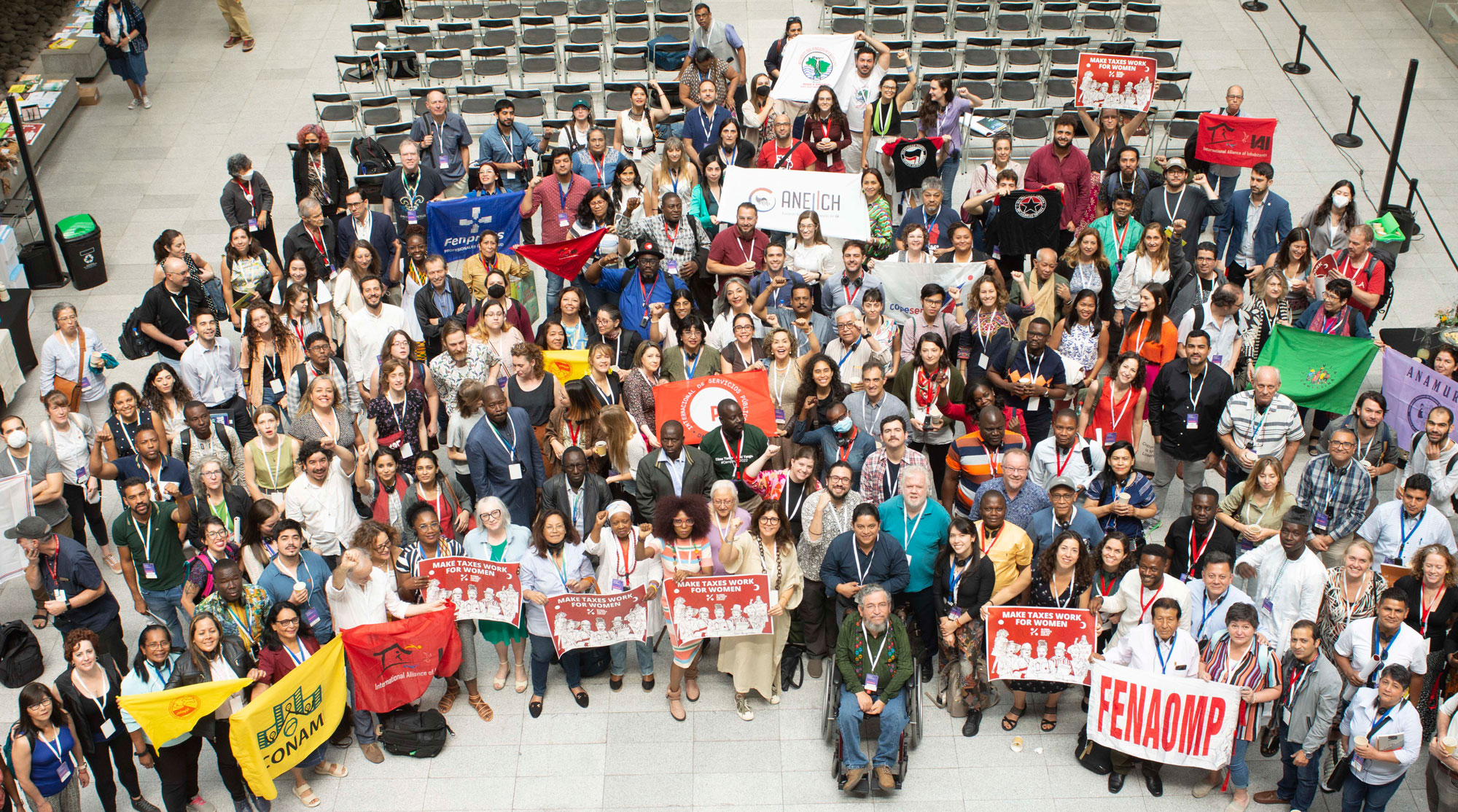
GI-ESCR is proud to report the success of the Our Future is Public (#OFIP22) Conference. The Conference gathered social movements, trade unions and civil society organisations from all over the world in Santiago, Chile for a 4-day Conference aiming at developing strategies and narratives to strengthen public services for the realisation of economic, social and cultural rights and tackle the effects of climate change. The conference was attended by more than 400 people and many others participated virtually.
The result of which is the adoption of the Santiago Declaration which calls for universal access to quality, gender-transformative and equitable public services as the foundation of a fair and just society.
The result of which is the adoption of the Santiago Declaration which calls for universal access to quality, gender-transformative and equitable public services as the foundation of a fair and just society.
Victory through the International Finance Corporation’s decision to stop investing in fee-charging private schools
 Among the achievements of the Privatisation in Education and Human Rights Consortium (PEHCR), GI-ESCR and partners celebrated the decision by the World Bank’s International Finance Corporation not to resume investments in K-12 fee-charging private schools. In 2020, the IFC temporarily froze all direct and indirect investments in for-profit, fee-charging schools, from kindergarten to high school (K-12). The freeze has now been extended indefinitely. This decision, announced in June, followed the release of an evaluation by the World Bank’s Independent Evaluation Group (IEG) of IFC’s investments in this area, which confirmed concerns that GI-ESCR and partners have been raising for years. The IFC noted that most private K–12 schools are difficult to invest in directly and cited several challenges, including weak financial results and the "potential for investments in private K–12 schools to exacerbate inequalities and have unintended, undesirable spillovers into the public sector school system". This decision vindicates the monitoring and advocacy of GI-ESCR and partners, who have argued for many years that commercial actors have a detrimental impact on education.
 The announcement came less than three months after the IFC indicated in March that it had divested from Bridge International Academies (BIA). BIA, also known as NewGlobe Schools, is a chain of for-profit schools that operate in five African countries and India.
At GI-ESCR we will continue to press other development finance institutions to follow IFC’s lead. We also want the World Bank Group to increase its support for public education systems that are equitable and aligned with human rights standards.
Our normative proposal was included in the draft constitution prepared by Chile’s Constitutional Convention
 In 2022, along with partners and as part of our programmatic work in Chile, we submitted to the Chilean Constitutional Convention a normative proposal for universal public services of good quality. The proposal was accepted by the Constitutional Convention and eventually included into the draft constitution.
 The proposal was inspired by the Global Manifesto for Public Services and the Principles of Human Rights in fiscal policy. It reflected our advocacy work to recognise ESC rights in Chile’s new Constitution and also fulfilled our programmatic objective to strengthen the capacity of national human rights frameworks to tackle social and economic injustice effectively.
The proposal was submitted through the popular initiative instrument (iniciativa popular de norma), a direct democracy mechanism created during the 2022 Constitutional process. The procedure enabled citizens and organisations to submit to the official constitutional debate any proposal that gathered the support of at least 15.000 signatures. Our proposal was among the 77 proposals (out of 2,495) that the Constitutional Convention deliberated.
The victory was bittersweet, however. The draft proposed by the Constitutional Convention was subsequently rejected in a referendum in September 2022. Despite the setback, we learned critical lessons that will help us to engage in the new constitutional process that is due to begin in 2023.
Overall, GI-ESCR successfully developed and strengthened working partnerships with national and international trade unions, civil society and grassroots organisations. These alliances enabled us to gather the signatures required by the constitutional process and then influence the work of the Constitutional Convention. While it is difficult to predict whether a new constitutional process will include this provision, we believe our initiative successfully linked public services, fiscal policies and ESC rights to the public agenda for the first time. This change has already shaped public and political perceptions of these issues and will influence their inclusion in future phases of the constitutional process.
Victory for indigenous women in Mexico who are fighting for a just energy transition
 After years of advocacy, the Zapoteca indigenous community of Unión Hidalgo in Mexico achieved a significant victory over a transnational company that had failed to deliver a just energy transition. On 3 June 2022, Mexican authorities cancelled a large wind energy project that Electricité de France (EDF), a transnational French energy company, was planning to build on their territory without their participation or free, prior and informed consent. For several years, the community had denounced human rights abuses committed by those developing the energy project. These disproportionately affected indigenous women and girls, and included loss of access to their land and to natural resources on which their and their families’ livelihoods depended. GI-ESCR was privileged to collaborate with ProDESC, a local organisation in Mexico that has led litigation and advocacy in defence of the indigenous community of Unión Hidalgo since 2019. To combat the escalating climate emergency, it is necessary to shift from fossil fuels to renewable energy but also to deliver a gender-just transition that protects the planet and its people.
 The case of Unión Hidalgo is paradigmatic because it reflects the structural problems that commonly occur during energy transition processes, and specifically highlights the fact that capital-intensive renewable energy projects may have adverse human rights impacts on communities, notably women.
We influenced the education sector in Côte d'Ivoire
 In 2022, we published a joint report with our partner, Movement Ivoirien des Droits Humains, on the impact of privatised and commercialised education on the right to education in Côte d'Ivoire in light of the Abidjan Principles.
 In the report, we recommended that the placement of students by the government in private schools (due to a lack of public schools) should depend on a set of criteria ensuring quality education in those schools. Such a rule would strengthen the regulation of private schools. We also recommended that the Education Act should be reviewed to align it with the Abidjan Principles on the human rights obligations of States to provide public education and to regulate private involvement in education.
Following an education sector review, the Ministry of Education decided to implement both of these recommendations in 2023.We influenced the education sector in Côte d'Ivoire
2021
Manifesto for Public Services

Working alongside other members of the Public Services Facilitation Group, for which it acted as secretariat, GI-ESCR played a leading role in developing the ‘Global Manifesto for Public Services’. This landmark initiative calls for a new approach to public services that will address current crises and build more sustainable, socially just and resilient economies and societies.
The COVID-19 pandemic has revealed starkly the consequences of decades of privatisation and commercialisation of services essential for human dignity. The manifesto offers detailed alternatives to a neoliberal model that has failed to protect human rights and provide a dignified life for all. It argues that public services are the foundation of fair and just societies and underpin a social pact that depends on core values of solidarity, equality and human dignity. It advances ten principles for universal and excellent public services for the 21st century and outlines how they can be funded.
The Manifesto was developed through a participatory, collective process that brought together actors from across civil society, academics and a range of social movements. It provides a unified vision, making joint work possible, and addresses questions, such as the role of the State and the scope of services, that had hindered collective action. Within a few weeks of its launch on 25 October 2021, the Manifesto had been endorsed by 199 organisations and it is now available in 7 languages.
It will remain open for signature throughout 2022 and is an unprecedented platform for collective action that enables a broader range of actors than ever before to scale up their action in the coming months and years. Public Services International and GI-ESCR have already used the Manifesto to develop a proposal on public services
for Chile’s constitutional process.
In November 2021, we convened Enough is enough II: The Future is Public. This event brought together nine human rights representatives to reflect on the crucial role of public services during and after the COVID-19 pandemic and transition to a more sustainable and resilient economy and society. The panel discussion was
watched by over 500 participants from across the world.
The COVID-19 pandemic has revealed starkly the consequences of decades of privatisation and commercialisation of services essential for human dignity. The manifesto offers detailed alternatives to a neoliberal model that has failed to protect human rights and provide a dignified life for all. It argues that public services are the foundation of fair and just societies and underpin a social pact that depends on core values of solidarity, equality and human dignity. It advances ten principles for universal and excellent public services for the 21st century and outlines how they can be funded.
The Manifesto was developed through a participatory, collective process that brought together actors from across civil society, academics and a range of social movements. It provides a unified vision, making joint work possible, and addresses questions, such as the role of the State and the scope of services, that had hindered collective action. Within a few weeks of its launch on 25 October 2021, the Manifesto had been endorsed by 199 organisations and it is now available in 7 languages.
It will remain open for signature throughout 2022 and is an unprecedented platform for collective action that enables a broader range of actors than ever before to scale up their action in the coming months and years. Public Services International and GI-ESCR have already used the Manifesto to develop a proposal on public services
for Chile’s constitutional process.
In November 2021, we convened Enough is enough II: The Future is Public. This event brought together nine human rights representatives to reflect on the crucial role of public services during and after the COVID-19 pandemic and transition to a more sustainable and resilient economy and society. The panel discussion was
watched by over 500 participants from across the world.
Indigenous Women of Unión Hidalgo
 With ProDESC, a Mexican civil society organisation, GI-ESCR helped identify the gender impact of a large wind park built in the Zapotecan indigenous community of Unión Hidalgo, in the windswept Isthmus of Tehuantepec, Mexico. We organised a dialogue with women human rights defenders in the community at which they analysed the disproportionate impacts on women’s rights of the project. Their experience reflects a trend. Global energy transition programmes tend to privilege land and capital-intensive renewable energy projects that do not share their benefits with local communities and shift most of the social and environmental costs onto the local community.
We presented the women’s analysis in a communication to United Nations Special Rapporteurs. Four Rapporteurs subsequently addressed allegation letters to Electricité de France, the French company developing the Gunaa Sicarú project, and to the States of Mexico and France. The letters requested the States and the company to uphold their human rights obligations to the Zapotecan community. They were signed by the Special Rapporteur on extreme poverty and human rights, the Special Rapporteur on the right to development, the Special Rapporteur on indigenous peoples’ rights, and the Special Rapporteur on the situation of human rights defenders.
The fact that four Special Rapporteurs addressed this case had impacts at several levels:
- It indicated the relevance and urgency of the human rights abuses committed during development of the Gunaa Sicarú wind park.
- It made recipients of the letters accountable and supported litigation, currently proceeding in France, to demand that the company respect the rights of the community of Unión Hidalgo.
- It assisted UN Special Rapporteurs to build their capacity to address issues of climate change and just transition and develop standards that should inform the energy transition activities of public and private actors.
- It raised public awareness that human rights provide valuable guidance during the global transition to a low carbon world.
- Finally and critically, it supported and recognised the women and the community of Unión Hidalgo.