

Accessibility Tools
In response to civil society’s mobilisation, 57 heads of States make a landmark commitment against commercialisation of education
Press release by 58 organisations, 2 December 2016
(Antananarivo, Nairobi, Uganda, Paris, Port-au-Prince, Quebec, Rabat) Whilst last Sunday 57 head of State and Governments of the Francophonie raised concerns regarding the development of commercialisation of education and reaffirmed their commitment in favour of public quality education in a landmark common declaration, a group of 302 organisations from 38 countries of the Francophone area launches this week a Call of the Francophone civil society against commercialisation of education.
This call represents an exceptional mobilisation of the Francophone civil society, in response to the unprecedented global phenomenon of privatisation of education.
“Many African countries have seen an explosion in the number of private schools during the last decade, in particular low quality low cost schools, which target the poorest people. Since 2000, the share of private institutions at the primary level has for instance increased from 10% to 17% in Burkina Faso and fivefold in Mauritania”, observes Samuel Dembelé, president of the Africa Network Campaign on Education for All (ANCEFA).
Similarly, in Morocco, where the share of private education has more than tripled in only fifteen years, “the State has failed in its role of ensuring schools for all. Today the Moroccan State encourages privatisation and commercialisation of education as a solution to educational challenges faced by the country. The Head of government even declared that the moment had come for the State to disengage from education and health provision”, declares Ibtissam Mzibr, General Secretary of the Mouvement Anfass Démocratique (Morocco).
Yet, “research in many countries has demonstrated that privatisation of education has disastrous effects in terms of quality of educational content, of segregation and socio-economic inequalities, and hence on the fulfilment of human rights, which contravenes States’ legal obligations,” regrets Sylvain Aubry from the Global Initiative for Economic, Social and Cultural Rights (GI-ESCR),
The Call of the Francophone civil society against commercialisation of education warns against the different forms of commercialisation in the formal and non-formal education sectors, and opposes the transformation of education into a commercial product. It notably calls States to:
put in place public educational systems of quality and completely free of charge
regulate private education
eliminate educational establishments with a commercial purpose
“This Call demonstrates that privatisation of education is a crucial global challenge, and it constitutes an important tool of solidarity, for us who act daily in Haiti to redevelop our public education system, while 80% of educational establishments are private! This is due to decades of abandonment of public education by the Government, and to the support of the private sector by international donors such as the World Bank and the Global Partnership for Education” explains Mona Bernadel, from the Programme Collectif pour le Développement de l'Éducation et du Dialogue Social in Haïti.
In this context, the Antananarivo Declaration, which was signed in conclusion of the 2016 Francophonie Summit which took place in Madagascar on 26th and 27th November, and which includes a great part of the Francophone civil society’s demands, constitutes a major political commitment. The 57 signatory Member States of the International Organisation of La Francophonie (OIF) express concerns at paragraph 39 with the “development of academic and educational establishments with a commercial purpose”.
“We are particularly concerned with chains of private schools with a commercial purpose, such as Bridge International Academies, which has over 400 schools in Kenya, Uganda, and Liberia, and which promotes a low-quality and hyper-standardised education model”, denounces Carole Coupez of Solidarité Laïque. “If Francophone countries have not yet been as affected by these chains of schools, it is important that they mobilise prior, and that they promote at the international level another educational model that ensures social justice and the dignity of all”.
Francophone States additionally requested that the OIF, “in collaboration with civil society”, “take measures to promote efficient institutional mechanisms for the regulation of private actors in education, in order to ensure quality and equity of education services”.
Sonia Chebbi, of the Fédération Internationale des Céméa underlines that “the signatories of the Call now expect that the OIF implement this clear request of States: act to put in place efficient regulation of private actors in education. It is crucial to reinforce the joint work of civil society organisations, the OIF and States to defend and protect public educational systems of quality in the formal and non-formal education sectors.”
“The mobilisation of all must continue after this important step. We expect in particular from donor States that they support partner countries in the development of quality public education systems and in the regulation of private actors in education” added Hélène Ferrer, coordinator of the Education Coalition in France.
Luc Allaire, General Secretary of the Comité syndical francophone de l’éducation et de la formation concluded: “Quality education for all will only be achieved through compulsory, free, and universal public education. This is an indispensable tool to end educational inequalities that have been exacerbated by the privatisation and commercialisation of education, in Northern countries as well as in Southern countries.”
Key documents
Call of the Francophone civil society against commercialisation of education [in French]: http://bit.ly/2fNfJDh
Short version of the Call [in French]: http://bit.ly/2gfusmO
Summary of the Call [in French]: http://bit.ly/2gNjZlR
Map of the signatory organisations of the Call: http://bit.ly/2gE2gOj
Antananarivo Declaration [in French]: http://bit.ly/2gMyRS5
Information on the Antananarivo Declaration in English: http://bit.ly/2gaodDu
Information in French on privatisation of education: http://bit.ly/privfr and http://bit.ly/2bgvvQj
Information in English on privatisation of education: http://bit.ly/educprivat
Global campaign for education report, "Private profit public loss: why the push for low-fee private schools is throwing quality education off track", http://bit.ly/2fOiG1F
About the Francophone Network against commercialisation of education
This informal network was originally initiated by six organisations (the French Education Coalition, the Comité syndical francophone de l’éducation et de la formation, the Fédération internationale des Céméa, the Global Initiative for Economic, Social, and Cultural Rights, the Right to Education Project, and Solidarité Laïque) on the occasion of a symposium in March 2016. It now has 302 member organisations which signed the Call of the Francophone civil society against privatisation of education. The Network works to ensure a collective reflection and mobilisation concerning the growing role and impact of private actors in formal and non-formal education throughout the Francophone area, by bringing together in their diversity education actors (NGOs, associations, media, teachers, educators, unions, researchers…).
Contacts
For any information or interview request, contactEkaterina Mikhaylovaat
Signatures
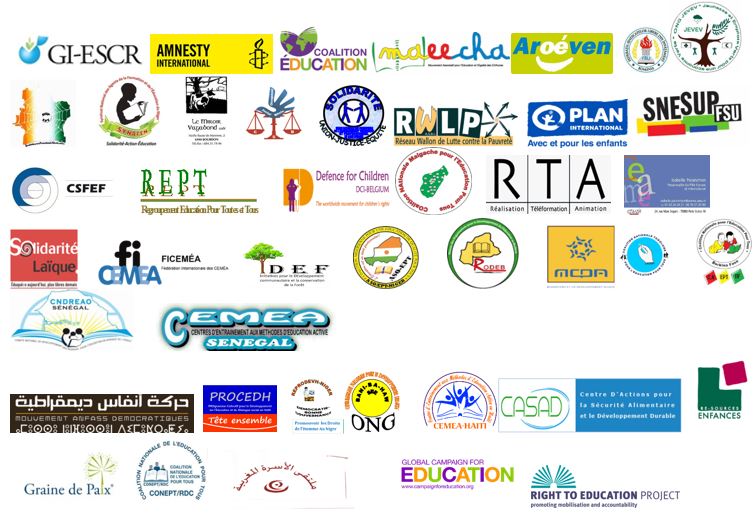
Contact
1. Amnesty International Mali, Mali,
2. Amnesty International/ Senegalese Section, Senegal,
3. ANCEFA International
4. Association Tchadienne pour le Bien Etre Familial, Tchad,
5. BANI BA HAW, Niger,
6. Campagne Mondiale pour l'Éducation International
7. Carrefour de la Famille Marocaine, Morocco,
8. CEMEA-F France
9. CEMEA-HAITI, Haiti,
10. Centre d'Actions pour la sécurité alimentaire et le Développement Durable, Benin,
11. Centre d'assistance à la diffusion des méthodes d'éducation active, Russia,
12. Centres d'Entraînement aux Méthodes d'Education Active du Sénégal (CEMEA Sénégal), Senegal
13. Coalition Éducation, France,
14. Coalition Nationale pour l'Education Pour Tous du Burkina Faso, Burkina Faso,
15. Coalition Nationale Togolaise pour l'Education Pour Tous, Togo,
16. Coalition Nigérienne des Associations, Syndicats et ONG de Campagne EPT (ASO-EPT Niger), Niger
17. Comité National de Développement des Réseaux pour l'Education en Afrique de l'Ouest (CNDREAO Sénégal), Senegal,
18. CONAMEPT, Madagascar,
19. CONEPT, DRC,
20. Conseil des Activités Educatives du Bénin (CAEB), Benin,
21. Conseil National des ONG de Développement, DRC
22. Construisons Ensemble le Monde, DRC,
23. CSFEF, International,
24. Défense des enfants international Belgique, Belgium,
25. Education Notre Vision (ONG ENVI), Niger,
26. Edugestion Cameroun, Cameroon,
27. Fédération des Aroéven, France,
28. Fédération des Syndicats Libres de l'Enseignement, Roumania,
29. FICEMEA, International,
30. Global Initiative for Economic, Social and Cultural Rights, International,
31. Graine de paix (AGP), Algeria,
32. Héritiers de la Justice, RDC,
33. IDEF - Initiatives pour le Développement communautaire et la conservation de la Forêt, Ivory Coast
34. Jeunesse et Emplois Verts pour une Economie Verte, Benin,
35. Maan promotion économique et culturelle des personnes risquant la précarité, Tunisia,
36. Migrations Co-développement Alsace, France / Morocco,
37. Miroir Vagabond, Belgium,
38. Mouvement Anfass Démocratique, Morocco,
39. Mouvement Associatif pour l'Education et l'Egalité des Chances, Comoros,
40. ONG Changement Social Bénin, Benin,
41. Plan International France, France,
42. PROCEDH, Haiti,
43. Réalisation Téléformation Animation, Belgium,
44. Regroupement Education Pour Toutes et pour Tous, Haiti,
45. Réseau des Acteurs de Développement de l'Éducation au Bénin (RADEB), Bénin,
46. Réseau des Organisations pour le Développement de l'Éducation au Burkina (RODEB), Burkina Faso,
47. Réseau des Organisations pour le Développement de l'Éducation au Burkina (RODEB), Burkina Faso,
48. Réseau Ivoirien pour la Promotion de l’Education Pour Tous (RIP-EPT), Ivory Coast,
49. Réseau Nigérien pour le Développement de la Femme (RENIDEF), Niger,
50. Réseau Progrès et Développement Humanitaire du Niger (REPRODEVH-NIGER), Niger,
51. Réseau Wallon de lutte contre la Pauvreté (RWLP), Belgium,
52. Re-Sources Enfances, Belgium,
53. Right to Education Project, International,
54. SNESUP-FSU, France,
55. Solidarité Laïque, France,
56. SOLIDARITE-UNAFETPCI (Union Nationale des Formateurs de l’Enseignement Technique et Professionnel de Côte d’Ivoire), Ivory Coast,
57. SYNAFEN NIGER, Niger,
58. Syndicat alternatif et indépendant du personnel de l'Education de La Réunion 2, France
PROGRAMME OFFICER -PUBLIC SERVICES
Ana Clara works as a Programme Officer on Public Services with the Global Initiative for Economic, Social, and Cultural Rights. She holds a master’s degree in Human Rights and Humanitarian Action from Sciences Po in Paris, where she focused on economic, social, and cultural Rights, and Latin American and gender studies. She holds a Bachelor of Laws from Universidade Federal de Mato Grosso in Brazil.
Ana Clara previously worked on litigation claims concerning the right to social security and the right to health at the Public Defender’s Office and Federal Court of Justice in Brazil. She also supported the work of the Special Rapporteur on Economic, Social, Cultural, and Environmental Rights of the Inter-American Commission on Human Rights. Recently, she worked on strategic litigation before the Inter-American Court of Human Rights as part of the team of the Center for Justice and International Law.
Ana Clara, country is Brazil (Based in Paris).
PROGRAMME OFFICER -PUBLIC SERVICES & REPRESENTATIVE FOR AFRICA
Ashina works as the Programme Officer for Public Services and Representative for Africa with the Global Initiative for Economic, Social and Cultural Rights. She is an Advocate of the High Court of Kenya, with an LL.B degree from the University of Nairobi, Kenya, and an LL.M (with distinction) in Human Rights and Democratisation in Africa from the Centre for Human Rights, University of Pretoria, South Africa.
Passionate about social justice, she has worked in the human rights sector for over six years at the intersection of global and national struggles for just systems of public service delivery to ensure everyone can enjoy their socio-economic rights, first at the Economic and Social Rights Centre-Hakijamii in Kenya and then at GI-ESCR. In particular, she has led and supported research and advocacy at local, national and global research and advocacy focused on the human rights legal framework relating to the rights to land, housing, education, health and water, for marginalised communities. Her research interests also include human rights and economic policy and the contribution that human rights obligations can make to the formulation and implementation of economic policy.
Ashina is based in Nairobi, Kenya.
SENIOR COMMUNICATIONS OFFICER
Belén has a BA in International Relations. She lived in India and the Philippines just after graduating where she volunteered for three years in health and education projects. Upon her return to Argentina, where she is native from, she joined Red Solidaria as volunteer and international aid coordinator. She worked as a journalist and program manager at La Nación newspaper foundation in Buenos Aires, to later become Social Media information specialist at the US Embassy in Buenos Aires. She acted there as Liaison Officer with other sections and became Grant Officer representative. She was selected to become HelpArgentina's Executive Director to help expand fundraising opportunities abroad for NGOs from other Latin American countries, and successfully transitioned the organization into PILAS, Portal for Investment in the Latin American Social Sector. From there she moved on to working at a new media startup, RED/ACCION, as Engagement Editor and Membership coordinator before joining us as Communications Officer.
Belén is based in Buenos Aires, Argentina.
RESEARCH ASSOCIATE
Lorena Zenteno is a PhD student at the University of Edinburgh. Her primary research interests include the human rights dimensions of climate change and environmental impacts, climate change justice, gender, and the judiciary’s role in the climate change crisis. Lorena has worked for several years in Chile, as a judge, as a law clerk, in the Court of Appeal of Concepcion, Santiago and in the Constitutional Chamber of the Supreme Court of Chile. She is a member of the Environment and Human Rights Commission of the National Association of the Chilean Judiciary, dedicated to study and discuss climate change and environmental impacts on human rights. Lorena is the Chilean National Rapporteur on Global Climate Litigation database for the Sabin Center for Climate Change Law of Columbia University.
She was a senior researcher for the former UN Special Rapporteur on Cultural Rights, Karima Bennoune, from September 2018 until September 2021. Supported and assisted the UN Special Rapporteur to fulfil his mandate to the UN General Assembly and UN Human Rights Council.
She holds an LL.B. from Universidad de Concepcion, a LL.M. in Environmental Law from the University of Davis, California, and a Master in Business Law from the University Pompeu Fabra, Barcelona, Spain. Lorena is a member of the the Global Network for the Study of Human Rights and the Environment.
Lorena is based in Geneva, Swiss.
PROGRAMME OFFICER -RIGHT TO EDUCATION
Zsuzsanna works as Right to Education Officer with the Global Initiative for Economic, Social and Cultural Rights. Prior to joining GI-ESCR, she assisted in the drafting process of the Abidjan Principles on the Right to Education and the development and publication process of the Commentary of the Abidjan Principles as a consultant. Previously, she has worked with the Open Society Justice Initiative as an Aryeh Neier Fellow on issues such as equality and non-discrimination, Roma rights, the right to education, economic justice, access to justice and the rule of law. She has also worked as a lawyer with the Hungarian Civil Liberties Union on educational segregation, Roma rights and hate crimes. She holds an LL.M in Public International Law from the University of Edinburgh and a Law Degree from the Eötvös Loránd University Budapest.
Zsuzsanna is based in Budapest, Hungary.
If you enjoy our work, please consider making a donation!
No amount is too small. Your contribution will help us fight for transformative change to end endemic problems of social and economic injustice.
The Global Initiative for Economic, Social and Cultural Rights is a 501(c)(3) non-profit organisation. Donations are tax-deductible in many countries, including the United States.
OFICIAL DE PROGRAMA - SERVICIOS PÚBLICOS Y REPRESENTANTE PARA ÁFRICA
Ashina es oficial del Programa para los Servicios Públicos y Representante para África de la Global Initiative for Economic, Social and Cultural Rights. Es abogada de la Corte Suprema de Kenia, egresada (LL.B) de la Universidad de Nairobi, Kenia, y con un máster (LL.M) en derechos humanos y democratización en África, completado con honores, en el Centro para los Derechos Humanos de la Universidad de Pretoria en Sudáfrica.
Ashina es una apasionada de la justicia social, y ha trabajado en el área de los derechos humanos en el marco de las luchas nacionales y mundiales por sistemas más justos de prestación de servicios públicos, que garanticen a todos el disfrute de sus derechos socioeconómicos. Primero trabajó en el Economic and Social Rights Centre de Hakijamii, Kenia, y luego, en el GI-ESCR. Concretamente, ha dirigido y apoyado la investigación y la defensa, a nivel local, nacional y mundial, del marco legal de derechos humanos para los derechos de las comunidades marginadas a la tierra, la vivienda, la educación, la salud y el agua. Sus intereses en la investigación se orientan también a los derechos humanos y las políticas económicas, así como a la contribución que el cumplimiento de los derechos humanos hace a la formulación y ejecución de las políticas económicas.
Ashina reside en Nairobi, Kenia.
OFICIAL DE PROGRAMA - DERECHO A LA EDUCACIÓN
Zsuzsanna es oficial del Programa de Derecho a la Educación de la Global Initiative for Economic, Social and Cultural Rights. Antes de unirse a GI-ESCR, colaboró, como consultora, en la redacción de los Principios de Abiyán sobre el derecho a la educación, así como en la elaboración y publicación del Comentario de los Principios de Abiyán. Previamente, Zsuzsanna trabajó con la Open Society Justice Initiative como becaria de la Aryeh Neier Fellowship, en temas como la igualdad y la no discriminación, los derechos de los romaníes (Roma Rights), el derecho a la educación, la justicia económica, el acceso a la justicia y el estado de derecho. También ha trabajado como abogada con la Hungarian Civil Liberties en la segregación educativa, los derechos de los Romaníes y los crímenes de odio. Tiene un máster (LL.M) en derecho público Internacional por la Universidad de Edimburgo y una licenciatura en Derecho por la Universidad Eötvös Loránd, Budapest.
Zsuzsanna reside en Budapest, Hungría.
SENIOR AGENT DE COMMUNICATION
Belén est titulaire d’un BA en relations internationales. Juste après avoir obtenu son diplôme, elle a vécu en Inde et aux Philippines, où elle s'est portée volontaire pendant trois ans pour des projets de santé et d'éducation. À son retour en Argentine, d'où elle est originaire, elle a rejoint Red Solidaria en tant que volontaire et coordinatrice de l'aide internationale. Elle a travaillé comme journaliste et responsable de programme à la fondation du journal La Nación à Buenos Aires, pour devenir ensuite spécialiste de l'information sur les médias sociaux à l'ambassade des États-Unis à Buenos Aires. Elle y a joué le rôle d'agent de liaison avec les autres sections et est devenue représentante des agents de subvention. Elle a été choisie pour devenir la directrice exécutive de HelpArgentina afin d'aider à développer les possibilités de collecte de fonds à l'étranger pour les ONG d'autres pays d'Amérique latine, et a réussi la transition de l'organisation vers PILAS, le portail d'investissement dans le secteur social latino-américain. Elle a ensuite travaillé pour une start-up de nouveaux médias, RED/ACCION, en tant que rédactrice chargée de l'engagement et coordinatrice des membres, avant de nous rejoindre en tant que responsable de la communication.
Belén vit à Buenos Aires, en Argentine.
OFICIAL ASOCIADO DE PROGRAMA- SERVICIOS PÚBLICOS
Ana Clara Cathalat colabora como socia en la Global Initiative for Economic, Social, and Cultural Rights, mientras prosigue con su máster en derechos humanos y acción humanitaria en la Universidad Sciences Po, París. Allí centra su interés en los derechos económicos, sociales y culturales y en estudios de género en América Latina. Tiene una licenciatura en derecho por la Universidad Federal de Mato Grosso, Brasil.
Previamente, Ana Clara trabajó en reclamaciones judiciales relacionadas con el derecho a la seguridad social y el derecho a la salud en la Oficina del Defensor Público y el Tribunal Federal de Brasil. Asimismo, apoyó la labor del Relator Especial en Derechos Económicos, Sociales, Culturales y Ambientales de la Comisión Interamericana de Derechos Humanos. Recientemente, trabajó en litigios estratégicos ante la Corte Interamericana de Derechos Humanos, como miembro del equipo del Centro por la Justicia y el Derecho Internacional.
Ana Clara, Brasil. (Reside en París).
INVESTIGADORA ASOCIADA
Lorena Zenteno es estudiante de doctorado en la Universidad de Edimburgo. Entre sus principales intereses de investigación se encuentran el impacto del cambio climático y su efecto ambiental sobre los derechos humanos, la justicia ambiental, el género y el papel del sistema de justicia en la crisis por el cambio climático. Trabajó varios años en Chile como jueza y como asistente jurídico en la Corte de Apelaciones de Concepción, Santiago, y en la Sala Constitucional de la Corte Suprema de Chile. Es miembro de la Comisión de los Derechos Humanos y Ambientales de la Asociación Nacional de Magistrados y Magistradas de Chile, la cual se dedica a estudiar el impacto del cambio climático y su efecto ambiental sobre los derechos humanos. Lorena es la relatora nacional chilena de la base de datos de los litigios por el cambio climático del Sabin Center for Climate Change Law de la Universidad de Columbia.
Trabajó como investigadora principal para la Relatora Especial sobre los Derechos Culturales de las Naciones Unidas, Karina Bennoune, desde septiembre de 2018 hasta septiembre de 2021. Apoyó y asistió al Relator Especial de las Naciones Unidas en sus labores ante la Asamblea General y el Consejo de Derechos Humanos de las Naciones Unidas.
Tiene una licenciatura en derecho por la Universidad de Concepción, un máster en derecho ambiental por la Universidad de Davis, California, y un máster en derecho empresarial por la Universidad Pompeu Fabra en Barcelona, España. Lorena es miembro de la Global Network for the Study of Human Rights and the Environment.
Lorena reside en Ginebra, Suiza.
Si le gusta nuestro trabajo, considere hacer una donación.
Ninguna cantidad es demasiado pequeña. Su contribución nos ayudará a luchar por un cambio transformador para poner fin a los problemas endémicos de la injusticia social y económica.
La Global Initiative for Economic, Social and Cultural Rights es una organización sin fines de lucro 501(c)(3). Las donaciones son deducibles de impuestos en muchos países, incluyendo Estados Unidos.
OFICIAL DE PROGRAMA - SERVICIOS PÚBLICOS Y REPRESENTANTE PARA ÁFRICA
Ashina es oficial del Programa para los Servicios Públicos y Representante para África de la Global Initiative for Economic, Social and Cultural Rights. Es abogada de la Corte Suprema de Kenia, egresada (LL.B) de la Universidad de Nairobi, Kenia, y con un máster (LL.M) en derechos humanos y democratización en África, completado con honores, en el Centro para los Derechos Humanos de la Universidad de Pretoria en Sudáfrica.
Ashina es una apasionada de la justicia social, y ha trabajado en el área de los derechos humanos en el marco de las luchas nacionales y mundiales por sistemas más justos de prestación de servicios públicos, que garanticen a todos el disfrute de sus derechos socioeconómicos. Primero trabajó en el Economic and Social Rights Centre de Hakijamii, Kenia, y luego, en el GI-ESCR. Concretamente, ha dirigido y apoyado la investigación y la defensa, a nivel local, nacional y mundial, del marco legal de derechos humanos para los derechos de las comunidades marginadas a la tierra, la vivienda, la educación, la salud y el agua. Sus intereses en la investigación se orientan también a los derechos humanos y las políticas económicas, así como a la contribución que el cumplimiento de los derechos humanos hace a la formulación y ejecución de las políticas económicas.
Ashina reside en Nairobi, Kenia.
RESPONSABLE DE PROGRAMME - DROIT À l’ÉDUCATION
Zsuzsanna travaille actuellement en tant que responsable du droit à l'éducation pour l'Initiative mondiale pour les droits économiques, sociaux et culturels. Avant de rejoindre GI-ESCR, elle a participé, en tant que consultante, au processus de rédaction des Principes d'Abidjan sur le droit à l'éducation et au développement et à la publication du Commentaire des Principes d'Abidjan. Auparavant, elle a travaillé avec l'Open Society Justice Initiative en tant que boursière Aryeh Neier sur des questions telles que l'égalité et la non-discrimination, les droits des Roms, le droit à l'éducation, la justice économique, l'accès à la justice et l'État de droit. Elle a également travaillé en tant qu'avocate pour l'Union hongroise des libertés civiles sur la ségrégation scolaire, les droits des Roms et les crimes haineux. Elle est titulaire d'un master en droit international public de l'Université d'Édimbourg et d'un diplôme de droit de l'Université Eötvös Loránd de Budapest.
Zsuzsanna vit à Budapest, en Hongrie.
CHARGÉE DE PROGRAMME ASSOCIÉE – SERVICES PUBLICS
Ana Clara Cathalat collabore actuellement, dans le cadre d’une bourse, à l’Initiative mondiale pour les droits économiques, sociaux et culturels, tout en préparant un master en droits de l'Homme et action humanitaire à Sciences Po Paris, où elle se spécialise en droits économiques, sociaux et culturels, ainsi qu’en études de genre et latino-américaines. Elle a une licence de droit de l’Université Fédérale du Mato Grosso au Brésil.
Ana Clara a auparavant travaillé sur des actions en justice relatives au droit à la sécurité sociale et au droit à la santé auprès du Bureau de l’aide juridictionnelle et de la Cour de justice fédérale du Brésil. Elle a également appuyé les travaux de la Rapporteuse spéciale sur les droits économiques, sociaux, culturels et environnementaux de la Commission interaméricaine des droits de l'Homme. Elle a récemment travaillé sur des actions en justice dans des cas stratégiques auprès de la Cour interaméricaine des droits de l'Homme, au sein de l’équipe du Centre pour la Justice et le Droit International (CEJIL).
Ana Clara, le pays est le Brésil (Basée à Paris).
ASSOCIÉE DE RECHERCHE
Lorena Zenteno est doctorante à l’Université d’Édimbourg. Ses principaux thèmes de recherche sont les dimensions du changement climatique et des problèmes écologiques relatives aux droits de l'Homme, la justice climatique, le genre, et le rôle de la Justice dans la crise du changement climatique. Lorena a travaillé pendant plusieurs années au Chili, comme juge et comme légiste, auprès des Cours d’appel de Concepción et Santiago et de la Chambre constitutionnelle de la Cour suprême du Chili. Elle fait partie de la Commission de l’environnement et des droits de l'Homme de l’Association nationale de la magistrature chilienne, dont la mission est d’étudier et de débattre des conséquences du changement climatique et des problèmes écologiques sur les droits de l'Homme. Lorena est la Rapporteuse nationale chilienne sur la base mondiale des actions en justice climatiques pour le Centre Sabin pour le droit du changement climatique de l’Université de Columbia.
Elle a occupé le rôle de chercheuse principale pour l’ancienne Rapporteuse spéciale sur les droits culturels de l’ONU, Karima Bennoune, entre septembre 2018 et septembre 2021. Elle a appuyé et soutenu la Rapporteuse spéciale de l’ONU dans l’accomplissement de son mandat conféré par l’Assemblée générale de l’ONU et le Conseil des droits de l'Homme de l’ONU.
Elle a une licence de droit de l’Université de Concepción, un master en droit de l’environnement de l’Université de Davis (California) et un master en droit des affaires de l’Université Pompeu Fabra de Barcelone (Espagne). Lorena fait partie du Réseau mondiale pour l’étude des droits de l'Homme et de l’environnement.
Lorena vit à le Chili, basé à Genève.
Si vous aimez notre travail, pensez à faire un don !
Aucun montant n'est trop petit. Votre contribution nous aidera à lutter pour un changement transformateur afin de mettre fin aux problèmes endémiques d'injustice sociale et économique.
L'Initiative mondiale pour les droits économiques, sociaux et culturels est une organisation à but non lucratif 501(c)(3). Les dons sont déductibles des impôts dans de nombreux pays, y compris aux États-Unis.
SENIOR OFICIAL DE COMUNICACIONES
Belén es licenciada en Relaciones Internacionales. Apenas se graduó, vivió en la India y en Filipinas, donde fue voluntaria durante tres años en proyectos de salud y educación. Al regresar a su nativa Argentina se incorporó a la Red Solidaria como voluntaria y coordinadora de ayuda internacional. Trabajó como periodista y gestora de programas de la fundación del diario La Nación en Buenos Aires, para luego convertirse en especialista en información de medios sociales en la Embajada de Estados Unidos en Buenos Aires. Allí actuó como oficial de enlace con otras secciones y se convirtió en oficial representante de los programas de subvenciones. Fue seleccionada como Directora Ejecutiva de HelpArgentina con la función de ampliar las oportunidades de recaudación de fondos internacionales de las ONG de otros países latinoamericanos, y logró la transición exitosa de la organización hacia PILAS, Portal para la Inversión Social en Latinoamérica. De allí pasó a trabajar en una nueva empresa de medios de comunicación, RED/ACCION, como editora y coordinadora de membresías, antes de unirse al equipo de la GI-ESCR como oficial de comunicaciones.
Belén reside en Buenos Aires, Argentina.
DIRECTORA EJECUTIVA
Camila cuenta con más de 14 años de experiencia en abogacía a niveles nacional, regional y multilateral, especializándose en la supervisión de investigaciones y litigios sobre diversos temas de derechos humanos. Ha residido en Buenos Aires, donde trabajó en el Centro de Estudios Legales y Sociales (CELS), coordinando esfuerzos internacionales durante cuatro años. Camila posee una maestría en Administración Pública y Política Pública de la Fundación Getulio Vargas en San Pablo y una licenciatura en Relaciones Internacionales de la Universidad de Brasilia.
Camila reside en Brasilia, Brasil.
.