
Social Rights In Chile's Constitutional Debate
ISSUE
It is a moment of change. After the fast advance of the global free-market agenda during the last four decades, the neoliberal paradigm is increasingly questioned by its outcomes: growing socioeconomic inequalities and massive ecological degradation. Moreover, the side-effects of deregulation of the economy and privatisation of public services have jeopardised the enjoyment of economic, social and cultural (ESC) rights around the globe.
Chile is now part of the tidal wave against laissez-faire policies and a pivotal point to drive new frameworks and institutional alternatives to move beyond the neoliberal hegemony. The call for greater recognition and guarantee of ESC rights has been at the heart of citizens’ demands, expressed through successive waves of social unrest, the unfinished constitutional process of 2016, and the social uprising in 2019 that led the democratic and participatory drafting of a new Constitution for the first time in the history of the country.
In this context, GI-ESCR has been working closely with partners at the international, regional, and national level, to promote the recognition of ESC rights in Chile’s constitutional debates.
Action
Our theory of change focuses on our capacity to facilitate the discussion within the larger ecosystem of stakeholders that determines decision making. For this purpose, we assembled evidence and developed new narratives, built broad coalitions for advocacy, and mobilised them to promote change in the institutional framework and public opinion.
GATHERING EVIDENCE FOR A NEW NARRATIVE
GI-ESCR has been researching and collaborating with partners since 2019 in setting cutting-edge human rights standards on issues ranging from green transition policies to public services. Through collective work and a focus on international and local experiences, we have:
-
Disseminated to Chilean partners the Global Manifesto for Public Services, created by GI-ESCR and other eight global organisations as a collective vision to mobilise a strong broad-based movement to demand public services for all.
-
Edited and published the book: “Social rights and the Constitutional Moment in Chile”, which convened 53 international experts advocating for the incorporation of economic, social, cultural and environmental rights in the new Constitution.
-
Organised the webinar series “Sin recursos no hay derechos” convening tax and fiscal justice experts with political leaders.
-
Edited and published the book “Más que Juanitas” (More than Juanitas), which compiled for the first time the experiences and views on ESC rights from different groups of women in Chile. More than 30 organisations drafted contents for this publication.
-
Co-organised a meeting with the economist Thomas Piketty and members of the Constitutional Convention to discuss topics of fiscal justice.
All those activities and contents helped us develop a starting point for a new narrative in the Chilean context: the declaration of a list of rights in the new Constitution is not enough to guarantee social rights and foster better living conditions for all. To accomplish that goal, it’s also necessary to include a gender perspective, establish the principles for a progressive fiscal policy and the incorporation of universal and quality public services. Chile risks social rights becoming a dead letter without those elements.

Magdalena Sepúlveda, GI-ESCR's exec. director, interviewed by CNN Chile about the book on social rights.

Meeting between the economist Thomas Piketty and members of the Constitutional Convention.

ESCR's executive director and the constituent Tatiana Urrutia during the launch of the book Más que Juanitas.
BUILDING A MOVEMENT
To advance this agenda, we worked along with other organisations to build and mobilise a coalition around fiscal justice with public sector trade unions, the “Tax and Fiscal Justice Network in Chile”. At the same time GI-ESCR and partners convened trade unions and civil organisations in a civil society assembly for public services. As a result, both networks drafted principles and priorities on these topics for the future Constitution and drew a pathway to bring it into the forefront of the constitutional debate in a successful manner.

Assemby of organisations for public services, convened by GI-ESCR and PSI.

Workshop for drafting a proposal of constitutional content on public services
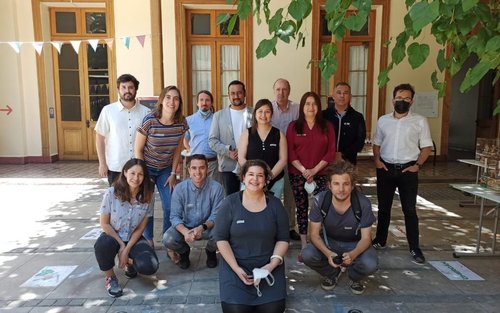
Representatives of the Citizen network for Fiscal Policy in Chile
GAINING MOMENTUM
Chile’s Constitutional Convention opened different channels to present proposals for the new chart. One was a citizen participation channel called Popular Initiative of Constitutional Content and another was the Initiative of Constitutional Content where the representatives could present normative proposals. The first mechanism required the collection of, at least, 15,000 citizens signatures for the proposal to be analysed and voted by the Convention. The second path needed the support of at least eight constituents to be discussed.
GI-ESCR and its partners decided to use both mechanisms simultaneously, mobilising one comprehensive initiative on public services and tax justice to guarantee social rights. In January 2022, GI-ESCR and partners unfolded a campaign to collect the 15,000 signatures under the slogan, “Without resources and public services, there are no social rights.” The campaign included social media, media coverage, and street points to collect signatures. GI-ESCR coordinated the campaign, which progressively gathered the support of new social movements and progressive think tanks, which helped spread the word and invite people to sign the petition.
At the same time, GI-ESCR led a round of meetings with members of the constitutional convention to present our proposal and ask for their support within the Convention. We approached 32 of the 154 members of the Convention.

Artwork sample of our campaign for the popular initiative of constitutional content

Gi-ESCR's team in the streets of Santiago, collective signatures for the popular initiative.

RESULT
GI-ESCR and its partners gathered 16,388 signatures supporting the popular initiative, which granted citizens legitimacy to our proposal. Simultaneously, they presented it to the convention with the support of 12 of its members. Therefore, GI-ESCR secured that the Constitutional Convention will discuss and vote on the incorporation of universal and quality public services and fair and progressive fiscal justice provisions.
INFLUENCING THE DEBATE
GI-ESCR also succeeded in influencing public opinion, spotlighting a key and unexplored topic in the constitutional debate through the mobilisation of a diverse group of constitutional representatives across the political spectrum, and diverse civil society organisations around the proposal, including social movements, public sector syndicates, NGOs, think tanks media outlets and academia.
GI-ESCR will continue coordinating the networks on public services and fiscal justice, broadening the range of partnerships and building trustworthy and meaningful relationships with the constitutional representatives that supported the proposal.
ALLIANCES
-
Public Services International
-
Amnesty International Chile
-
Agrupación Nacional de Empleados Fiscales (ANEF)
-
Asociación Nacional de Empleados del Poder Judicial (ANEJUD)
-
Asociación Nacional de Empleados de Impuestos Internos (ANEIICH)
-
Asociación de Fiscalizadores de Impuestos Internos de Chile (AFIICH)
-
Confederación Nacional de Empleados Municipales de Chile (ASEMUCH)
-
Confederación Nacional de Funcionarios de la Salud Municipal (CONFUSAM)
-
Confederación Nacional de Asistentes de la Educación Municipal de Chile (CONFEMUCH)
-
Confederación Nacional de Profesionales Universitarios de los Servicios de Salud (FENPRUSS)
-
Federación Nacional de Trabajadores de las Obras Sanitarias (FENATRAOS)
-
Fundación Ciudadanía Inteligente
-
Techo Chile - Fundación Vivienda - CES
-
Amnesty International Chile
-
Instituto Igualdad
-
Fundación Rumbo Colectivo
-
Fundación Nodo XXI
-
Friedrich Ebert Stiftung - FES Chile
-
Corporación Humanas
-
Corporación La Morada
-
Asociación de Familiares y Amigos de Prematuros (ASFAPREM)
-
Tremendas Chile
-
Network for Citizen Participation
-
University of Essex - Human Rights Centre
-
University of Concepción - Programme of Law. Enviroment and Climate Change, and Programme of European Studies
-
ONG FIMA
-
Observatorio Ciudadano
Media Coverage
-
02 February 2022 - 24 Horas - Revisa las 78 iniciativas populares que pasarán a ser discutidas en la Convención Constitucional
-
02 February 2022 - El Dínamo - Las 77 iniciativas populares que serán discutidas en la Convención Constitucional
-
02 February 2022 - Radio Agricultura - Un total de 78 iniciativas populares se discutirán en la Convención: El listado de las IPN que alcanzaron las 15 mil firmas
-
02 February 2022 - Chilevisión - De la defensa de ahorros previsionales al aborto: Las 78 iniciativas populares que serán discutidas en la CC
-
31 January 2022 - Radio Universidad de Chile (Chile) - Impulsan propuesta de norma para asegurar servicios públicos universales
-
31 January 2022 - El Desconcierto (Chile) - A un día para cierre del plazo: 60 iniciativas populares de norma logran firmas necesarias
-
29 January 2022 - El Ciudadano (Chile) - “Servicios públicos para la igualdad de género” (Public services for gender equality). An Op-Ed by Programme Officer Valentina Contreras and Nayareth Quevedo, PSI Secretary for the Southern Cone Subregion.
-
27 January 2022 - Página 19 (Chile) - Iniciativa Popular: Servicios Públicos Universales y de Calidad y Política Fiscal Justa para la Garantía de Derechos Sociales.
-
25 January 2022 - El Mostrador (Chile) - “Sin recursos ni servicios públicos no hay derechos": Sindicatos y organizaciones presentan iniciativa popular de norma para garantizar derechos sociales. Along with partners, GI-ESCR launched a popular initiative to include in the Chilean new Constitution the promotion of universal and quality public services and tax justice as mechanisms to guarantee economic, social and cultural rights in practice.
-
20 January 2022 - El Mostrador (Chile) - Servicios públicos para la igualdad de género: "La Convención tiene la capacidad de transformar las condiciones de vida de las mujeres". An Op-Ed by Programme Officer Valentina Contreras and Nayareth Quevedo, PSI Secretary for the Southern Cone Subregion.
